How to Achieve Real-Time Inventory Visibility?
Real-time inventory visibility helps businesses see exactly what stock is available, allocated, in production, expected from suppliers, and ready to ship at any given moment. This article explains why inventory visibility is more complex in manufacturing, what can go wrong without it, and how to achieve it.

What does real-time inventory visibility mean?
Real-time inventory visibility means having an accurate, up-to-date view of inventory as stock levels, locations, and availability change across a business. However, this is more than basic stock taking or inventory cycle counting.
To have real-time visibility, inventory data must be connected to all business processes, including purchasing, production, sales, and shipping. This gives every department a clear view of what stock is available, which materials have been booked to orders, what stock is expected to become available, and which products are completed and ready to ship.
Why is having real-time inventory visibility important?
For e-commerce retailers, inventory management might simply mean knowing how many products are in stock across sales channels, what has already been allocated to customer orders, and what is available for order fulfillment. However, for manufacturers, inventory visibility is more complex because products are made, not just stored and sold. This requires complete inventory visibility across all business operations and the supply chain.
Tracking on-hand, allocated, and available stock
If you’re a manufacturer, real-time inventory visibility is important because it can show you what stock is on hand, allocated, or available to use at any given moment. This matters because a material may be physically in stock but already reserved for a customer order or booked to a manufacturing order.
When materials are allocated, consumed, returned, or shipped, their status should update across inventory, production, sales, and purchasing. This ensures you always have a clear view of what stock is available for manufacturing orders, and when more materials need to be ordered.
Visibility at every stage of production
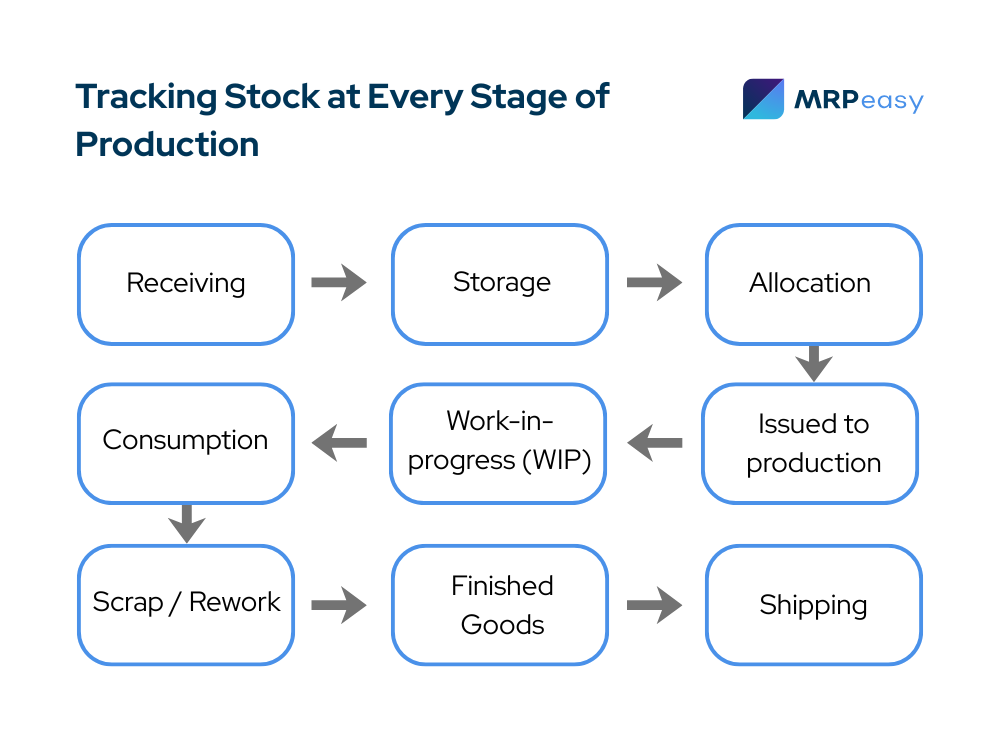
In manufacturing, stock changes location, status, and availability as it moves from purchasing to production to shipping. A typical inventory flow might look something like this:
- Receiving: Materials arrive from suppliers and are recorded into the system.
- Storage: Items are stored in the correct warehouse, bin, or location.
- Allocation: Stock is booked to a sales order, manufacturing order, or specific job.
- Issue to production: Materials are released to the shop floor.
- Work-in-progress (WIP): Materials are processed, assembled, or waiting between production stages.
- Consumption: Materials are marked as used during or after production.
- Scrap or rework: Damaged, wasted, or rejected materials are recorded in the system.
- Finished goods: Completed items are entered into stock as finished products.
- Shipping: Finished goods are picked, packed, shipped, and removed from inventory.
Real-time inventory control is important because it shows what materials are on-hand, allocated, WIP, consumed, and ready to ship, at any given moment. Without this real-time data, you can end up planning jobs around materials that are already used, promising orders that can’t be finished in time, or discovering shortages only after production has started.
Connect changes in inventory across the business
Real-time inventory visibility also means that all inventory data is integrated into one system. If you’re a manufacturer, having this integration is crucial. Purchasing, inventory, production, sales, and shipping all affect stock availability, so if each department works from separate spreadsheets, then everybody has a different view of inventory levels.
Having real-time visibility means that all these business processes are connected. For example, when a purchase order is received, production can see that the material is available. Or when materials are consumed on the shop floor, purchasing can see that more need to be ordered.
Every inventory change is reflected across the business, so teams can make informed decisions using the same up-to-date information. This means you can avoid double-booking materials, overpromising orders, or overlooking material shortages.
The impacts of poor inventory visibility
Stockouts
Stockouts can become commonplace if you don’t have up-to-date inventory visibility and alerts when stock is running low. This can have a detrimental effect on your business, because if even one crucial component is out of stock, this can halt production and delay shipments to customers.
This is exactly what happened with CDI, a sailing equipment manufacturer based in California. One of their products consists of around 50 parts, many of which have long lead times. They ordered one component too late, and as a result, couldn’t manufacture their product.
“We didn’t notice we needed one particular part and ordered it too late. By the start of the season, it hadn’t arrived. That cost us the whole season of sales for that particular furler,” says David, owner of CDI.
Now that they’ve implemented an MRP system that provides reliable inventory visibility and order management, these kinds of shortages are no longer a constant threat.
Stockouts also create production bottlenecks. When a job is scheduled but a required material is missing, then production has to stop, switch jobs, or wait for materials to arrive. These disruptions push back other orders and introduce inefficiencies on the shop floor.
Overstocking
If you don’t have good inventory visibility, then you might end up buying more materials than you need, “just in case”. While this approach prevents stockouts, it also drives up carrying costs, such as:
- Cash tied up in materials that have not yet been used or sold
- Storage space
- Risk of damage, expiry, or waste
- Extra labor required for counting, moving, and organizing materials
If storage areas are filled with excess materials, there’s also less room for fast-moving components, subassemblies, WIP, or finished goods waiting to ship.
Overpromising
If you’re a manufacturer, order availability depends on more than finished goods stock. You also need to know whether the right raw materials, components, subassemblies, packaging, labor, and production time are available. If that information is spread across disconnected systems, sales may be working from different assumptions, and overpromise on orders that production can’t fulfill.
Unsatisfied customers
Ultimately, when businesses don’t have an accurate inventory overview, customer satisfaction suffers. Overselling and stockouts lead to incomplete or late orders, which have a direct impact on customer satisfaction.
Customer satisfaction depends not only on product quality, but also on predictable delivery and clear communication. However, without an inventory system that can tell you exactly what’s available or when production can be completed, it’s difficult to give customers accurate and timely updates.
Late deliveries, unclear lead times, and last-minute changes damage customer trust and lead to lost sales. Customers may place fewer repeat orders, look for more reliable suppliers, or become less willing to recommend your business.
Benefits of real-time inventory visibility
Fewer stockouts and less excess inventory
Preventing stockouts can be difficult in manufacturing. However, software that gives you real-time visibility can help you understand what you need to order and by when. For example, MRPeasy makes stock levels, purchase orders, and planned production visible in one system, making it easy to spot shortages before they lead to stockouts.
Inventory tracking software can improve replenishment by letting you set reorder points. This means you get low stock alerts when materials fall below a critical level, giving you enough time to reorder before materials run out.
Finally, having a complete view of inventory allows procurement decisions to be made based on actual demand, planned production, and supplier lead times, which prevents excess inventory and the costs that come with it.
Better forecasting, planning, and scheduling
Inventory management software provides a complete overview of current stock, purchase orders, supplier lead times, and planned production. The result is more accurate demand forecasting, planning, and scheduling.
Production planning: Real-time inventory visibility makes production planning more accurate because planners can check whether each job has the required materials, components, subassemblies, and packaging, before it’s released to the shop floor. If something is missing, they can purchase the material, reschedule the job, or prioritize another order.
Scheduling: Real-time tracking of inventory lets you prioritize work based on actual material availability rather than assumptions. A job may look urgent, but if your inventory system shows a key material is missing, you can prioritize another fully ready job. This keeps production moving and reduces last-minute schedule changes.
Forecasting: By comparing forecasted demand against current stock, allocated materials, BOM requirements, open purchase orders, and supplier lead times, manufacturers can see whether future demand is realistic. This comparison turns demand forecasting from a standalone estimate into an input for inventory, purchasing, and capacity decisions.
Improved customer experience
Real-time inventory software can help you give customers more accurate answers about when an order can be made and delivered. Instead of quoting a lead time based on guesswork, you can check whether you have the materials and production capacity to actually complete the order.
If discrepancies do occur, having good inventory visibility also improves communication with customers. If a material shortage, late purchase order, or production delay affects an order, manufacturing software can show you the problem, and you can update the customer immediately. Fast communication with customers can help you manage customer expectations.
How to achieve real-time inventory visibility
Maintain accurate item, SKU, and location data
Accurate inventory records are the foundation of real-time inventory visibility. When you have complete and accurate data, every stock movement is recorded against the right item in the right place. This gives you a reliable view of what stock is on hand, available, and where it can be found.
If stock data is inaccurate, your system may show inventory that’s not actually usable. For example, if stock is recorded in the wrong warehouse, it may appear available in the system but cannot be found by shop floor workers when they actually need it.
Another example is if the same material has more than one SKU. The system treats it as separate items and can split the stock count across duplicate records, making it look like there is less available stock than there really is.
Units of measure also need to be consistent. If a BOM requires a material in grams but inventory is recorded in kilograms, liters, rolls, or packs, the system needs to convert those units correctly. Otherwise, material requirements and availability calculations may be inaccurate.
Keep BOMs up to date
Accurate and up-to-date BOMs are essential to achieving real-time inventory visibility. If BOM data is incorrect, your inventory management system might show you have enough stock to complete an order, when in reality, you need to order more materials.
Accurate BOM data becomes even more important when dealing with multi-level BOMs, where a finished product may depend on many subassemblies, each with components of their own. The finished product may look ready to make, but if even one lower-level item in the BOM is wrong, it can throw off the whole production.
To keep your BOMs accurate and up-to-date, review and update them on a regular basis, especially whenever products, materials, or suppliers change. Also, make sure to define quantities, units of measure, and any product variations that affect material requirements.
Implementing software with a version control functionality is also essential if your BOM requirements change constantly.
Track work-in-progress (WIP)
Tracking work-in-progress can be challenging. Raw materials can be issued to a job, partially consumed during operations, scrapped, reworked, or converted into finished goods. Without good WIP visibility, it’s hard to keep track of an item’s status and maintain inventory accuracy.
A warehouse management module can help track where materials are stored, picked, or received. However, WIP tracking requires visibility into what happens after materials leave storage and enter production.
While WIP tracking functionality can automate many inventory updates, real-time visibility of WIP requires shop floor workers to record stock movements as they happen, such as when:
- Materials are issued to production
- Materials are consumed
- Operations are started, paused, or completed
- Jobs are delayed or waiting for materials
- Products are scrapped or reworked
- Finished goods are completed
When shop floor workers enter this information into a manufacturing execution interface, the changes are reflected across the system, helping streamline production reporting and inventory updates.
Use barcode scanning or RFID
Manually entering item information into a spreadsheet or inventory management software can become unmanageable for growing manufacturers. Having a barcode, RFID, or IoT-enabled tracking system makes it easier to record stock movements in real time.
With a barcode inventory system, employees can scan an item with a smart device and the system records the stock movement against the correct item, order, and location. RFID can serve a similar purpose, but instead of scanning items one by one, RFID tags can be read automatically or in batches, depending on the setup.
Use dashboards, alerts, and reports
Dashboards, alerts, and reports present inventory information in a way that is easy to understand and act on.
A dashboard gives you a comprehensive overview of your inventory and production operations. It can help your team see the most pressing issues at a glance, such as current stock levels, late purchase orders, and items below their reorder point.
Alerts are especially useful, as they can notify you of small issues before they turn into big problems. For example, if a critical component falls below its reorder point, a manufacturing ERP can send you an email alert to remind you to order more of the material. This prevents low stock from turning into a material shortage and a delayed job.
Finally, production reports can give you a long-term view of inventory. They can show patterns like recurring stockouts, slow-moving materials, or suppliers that frequently deliver late. Reviewing reports can help you optimize purchasing, production planning, and inventory control over time.

Why ERP software is essential for real-time inventory visibility
To achieve real-time inventory visibility, sales, purchasing, inventory, and production all need to work from the same source of truth. Without an integrated system, inventory data is split across spreadsheets, different accounting tools, and email communications. This makes it difficult for different departments to know what stock actually available in real time, especially when it’s constantly moving through purchasing, production, WIP, and shipping.
Manufacturing ERP software is essential because it connects all the workflows and departments that affect inventory. When someone updates inventory in one area, the change is instantly reflected across the entire ERP system.
Instead of each department working from different records, the whole business can see the same up-to-date view of inventory, production, purchasing, and order status. This kind of visibility has a measurable impact, with 82% of small manufacturers reporting improved inventory accuracy after implementing ERP software.
ERP systems also include manufacturing-specific tools that support real-time visibility. For example, built-in manufacturing execution systems connect shop floor activity with inventory management. This allows shop floor workers to update the system when materials are consumed, jobs are completed, or finished goods are entered into stock.
Key takeaways
- Real-time inventory visibility is more than stock counting: It means connecting inventory data with purchasing, production, sales, and shipping so every team can see what is available, allocated, expected, and ready to ship.
- Manufactur
- ers need visibility beyond finished goods: They need to track raw materials, components, subassemblies, WIP, finished goods, and stock status across every stage of production.
- Poor inventory visibility leads to stockouts, overpromising, and unhappy customers: One missing component can halt production, while unclear availability can cause sales teams to promise orders that cannot be delivered on time.
- Accurate data is the foundation of real-time visibility: Clean SKUs, correct stock locations, consistent units of measure, updated BOMs, and reliable WIP tracking are all needed for inventory software to show accurate availability.
- ERP software is the foundation for real-time inventory visibility: A manufacturing ERP connects inventory, purchasing, production, shop floor activity, and order status in one system, so updates in one area are reflected across the business.
Frequently asked questions (FAQ)
Real-time inventory visibility does not always mean every movement is updated automatically by sensors or RFID. For most small manufacturers, it means inventory is updated immediately when key actions happen, such as receiving materials, issuing stock to production, completing jobs, or shipping orders.
Inventory accuracy means the stock records match what is physically available. Inventory visibility goes further by showing where stock is, whether it is allocated, what is in WIP, what is expected from suppliers, and how inventory changes affect purchasing, production, and sales.
They can improve visibility with better spreadsheets, barcode tools, or standalone inventory software, but these usually become limited once production, purchasing, sales, and shop floor activity need to stay connected. A manufacturing ERP is usually the more scalable option because it updates inventory across all related workflows from one system.
You may also like: Lean Warehouse Management – A Practical Guide for SMEs
Get manufacturing know-how delivered to your inbox!