Inventory Software vs. ERP: Which Is Better for Manufacturers?
At one point, every serious manufacturing business needs dedicated software to manage its operations. While inventory management is often the first pain point for manufacturers, narrow inventory management software might not be the best option for them.
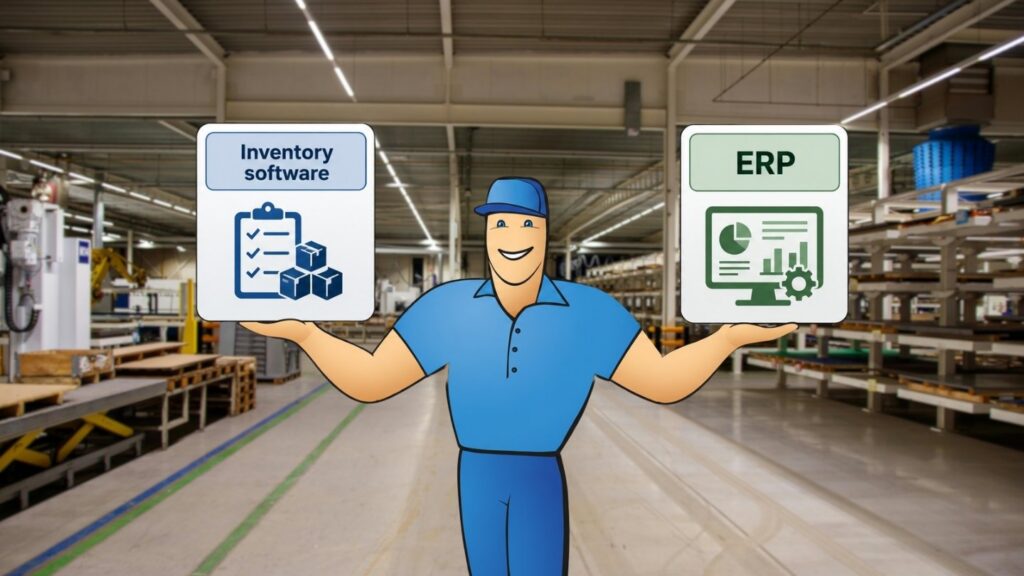
Manufacturers need integrated solutions
For manufacturers, inventory is never just inventory. Raw materials, components, work-in-process, finished goods, purchase orders, sales orders, bills of materials, supplier lead times, production schedules, and product costs are all connected. If one part of that chain is disconnected, the whole operation becomes harder to manage.
That is why the choice between inventory software and ERP matters. Both can support inventory management, stock control, warehouse management, and inventory tracking. But for manufacturers, the real question is not simply which system tracks stock better. The real question is which system can connect inventory with sales, quoting, procurement, material planning, production, costing, and order fulfillment.
Standalone inventory software can be useful at first. It can replace spreadsheets, improve stock visibility, support barcode scanning, manage stock keeping units, and make warehouse operations more organized. But as manufacturing complexity grows, inventory software often becomes too narrow. It may show what is in stock, but not why that stock is needed, which job it is allocated to, what needs to be purchased, or how material usage affects product costs.
At that point, inventory software can become an obstacle rather than a reliable management tool. When production planners continue working in spreadsheets, buyers manually calculate procurement needs, sales teams quote without reliable material or cost data, and finance struggles to reconcile inventory movements with the general ledger, the system improves one part of the business while leaving the rest disconnected.
For most growing manufacturers, this is where manufacturing ERP becomes the better long-term choice.
What is inventory software?
Inventory software helps companies track, control, and manage stock. It usually includes tools for stock levels, inventory tracking, reorder points, SKU management, barcode scanning, purchasing, warehouse management, and basic reporting.
For retailers, wholesalers, distributors, and simple warehousing businesses, this may be enough. Their inventory flow is often straightforward: buy goods, receive them, store them, sell them, pick them, pack them, and ship them.
Manufacturers work differently. They transform raw materials into finished products through production. Components are consumed according to a bill of materials. Materials may be reserved for specific jobs. Stock may move between warehouses, shop floor locations, workstations, subcontractors, and finished goods inventory. The same item may be available, allocated, on order, in inspection, in production, or already consumed but not yet reported.
Inventory software can still help manufacturers improve visibility and reduce manual work, especially when replacing spreadsheets. It can help companies reduce stockouts, prevent overstocking, and bring more structure to warehouse operations. But it works best when the main problem is stock control, not full manufacturing management.
The limitation is scope. Inventory software manages stock, but it does not manage the full chain of activities that create, move, consume, purchase, cost, and sell that stock.
What is manufacturing ERP?
ERP stands for enterprise resource planning. In general, ERP systems connect different areas of a business, such as sales, purchasing, inventory, accounting, CRM, and reporting. But manufacturers should be careful not to confuse general ERP with manufacturing ERP.
Manufacturing ERP software is designed specifically for companies that make products. It connects inventory management with production planning, material requirements planning (MRP), procurement, BOMs, routings, quoting, costing, sales orders, purchase orders, shop floor reporting, warehousing, and order fulfillment.
For example, when a sales order is confirmed, a manufacturing ERP system can check finished goods availability, calculate required raw materials, compare demand against current stock levels, review open purchase orders, identify shortages, create manufacturing orders, and support production planning. When materials are consumed, inventory is updated. When production is completed, finished goods are received into stock. When the order is shipped, inventory and order fulfillment data are updated again.
This creates a connected flow of real-time data across the business. Instead of each team maintaining its own spreadsheet or tool, sales, purchasing, production, warehouse, and finance teams work from the same operational system.
Why inventory cannot be separated from production
In a manufacturing business, stock levels do not tell the whole story. A component may be physically in the warehouse but already allocated to another job. A finished product may be in stock but reserved for a customer. A raw material may look available in the system, but production may have already consumed it on the shop floor. A purchase order may be open, but the supplier may not deliver in time for the planned production date.
This means that inventory tracking alone is not enough. Manufacturers need to understand availability in context.
That context comes from BOMs, sales orders, material planning, procurement, and production schedules.
- A bill of materials defines which materials and components are required to make a product;
- Material planning uses BOMs, demand, lead times, current stock levels, and open orders to calculate what needs to be purchased or produced;
- Production planning determines when materials are needed;
- Procurement ensures they arrive on time;
- Costing shows how material, labor, and overhead affect profitability.
If these functions are disconnected from inventory management, the company may have stock data but still lack operational control.
This is where standalone inventory software often becomes frustrating. It may give warehouse staff better visibility, but production planners still have to work outside the system. Buyers still have to manually check requirements. Sales teams still need to ask whether an order can be delivered. Managers still do not have a reliable view of production readiness, cost, or capacity.
Where inventory software falls short for manufacturers
Standalone inventory software usually starts to fall short once manufacturers need more than basic stock control.
One common problem is material planning. Many inventory systems use reorder points to trigger purchasing. Reorder points can be useful for stable, predictable items, but they are not the same as MRP. A reorder point tells you when stock has dropped below a minimum level. MRP calculates what materials are needed based on actual demand, BOMs, open sales orders, purchase orders, lead times, and production plans.
For manufacturers, that difference is critical. A material may be above its reorder point today but still be insufficient for next week’s production schedule.
Another problem is quoting and costing. Manufacturers need to know whether they can make a product profitably before accepting an order. That requires accurate data on raw materials, labor, subcontracting, overhead, and current purchase prices. If sales teams quote using outdated spreadsheets or rough estimates, margins can quickly become unreliable.
Inventory software can also struggle when production changes. If a customer changes an order, a supplier delivery is delayed, or a BOM is updated, the impact should flow through purchasing, materials management, production planning, and delivery dates. If those workflows are managed in separate tools, every change creates manual work and more room for error.
Ultimately, the result is more effort spent on administrative work, constant firefighting, and eroded margins.
Why manufacturing ERP is usually the better choice
Integration with the whole operation
Manufacturing ERP is usually the better choice because it connects inventory with the processes that actually drive inventory.
A manufacturing ERP system can show what is in stock, what is required for production, what is already allocated, what needs to be purchased, which jobs are waiting for materials, which sales orders can be fulfilled, and how material usage affects product costs.
This gives manufacturers a more complete view of the business. Sales can see whether products are available or need to be made. Purchasing can generate purchase orders based on real demand. Production planners can schedule work according to material and capacity availability. Warehouse staff can issue materials to production and receive finished goods. Finance can connect inventory valuation, work-in-process, cost of goods sold, and the general ledger more reliably.
This is the main advantage of ERP inventory management: it connects inventory management to sales, procurement, production, and costing.
For SMBs, this connection can have a major impact on operational efficiency. Small and medium manufacturers often lack the capacity to manually coordinate every detail. If sales, purchasing, production, and warehousing are all using separate tools, people spend too much time checking, updating, and reconciling information. Manufacturing ERP reduces that burden by providing manufacturers with a single source of truth.
Automation and real-time data
Automation is one of the biggest advantages of manufacturing ERP over standalone inventory software.
In a disconnected setup, teams often transfer information manually between systems:
- Sales confirms an order
- Someone checks stock
- Planners calculate material requirements
- Purchasing creates purchase orders
- Production updates the schedule
- Warehouse staff issue materials
- Finance later reconciles costs.
Every manual handoff creates delay and risk.
Manufacturing ERP reduces these handoffs:
- Sales can see inventory availability;
- If inventory is not available, a sales order can be quickly converted into a manufacturing order;
- Material requirements for the order can be calculated with a few clicks;
- Purchase orders can be generated from shortages;
- Production will be scheduled based on available materials and capacity;
- Inventory movements update stock levels in real time;
- Costing can use actual material and production cost data.
This does not mean every decision should be fully automatic. Manufacturers still need human judgment. But automation helps remove routine admin and gives teams better data for decision-making.
Real-time inventory tracking is especially important. If the system is only updated after the fact, planners and buyers are always working with yesterday’s information. A manufacturing ERP system helps keep inventory, production, purchasing, and order fulfillment data up-to-date at all times.
Supply chain and procurement visibility
Inventory problems are often supply chain problems. Supplier delays, inaccurate lead times, poor demand forecasting, and disconnected procurement can all lead to stockouts, late orders, and overstocking.
Manufacturing ERP improves supply chain management by connecting procurement with actual production needs. Instead of buying only when stock levels fall below reorder points, buyers can see which materials are required for upcoming jobs, when they are needed, and which suppliers can provide them.
This makes procurement more predictable. Buyers can manage purchase orders based on demand planning, MRP recommendations, supplier lead times, and production schedules. They can also see how delays affect manufacturing orders and customer deliveries.
Costing and financial control
Another major reason manufacturers need ERP inventory management software is costing.
In manufacturing, product cost is not limited to the purchase price of materials. It may include raw materials, labor, machine time, subcontracting, overhead, scrap, and rework. If these costs are managed in spreadsheets or disconnected systems, it becomes difficult to know whether products are truly profitable.
Manufacturing ERP connects inventory and production with costing:
- Material usage can be linked to production orders
- Purchase prices can inform material costs
- Labor and overhead can be assigned to products
- Finished goods can be costed more accurately
This also improves accounting. Inventory value, work-in-process, and the cost of goods sold are all affected by manufacturing activity. If inventory and production are disconnected from accounting, finance teams spend more time reconciling data and correcting errors.
Many manufacturers integrate accounting systems such as Xero or QuickBooks Online with their ERP. In that setup, the manufacturing ERP manages operational data while financial transactions are passed to accounting. This keeps production, inventory, and costing in the system designed for manufacturing while maintaining clean financial records.
Implementation costs: inventory software vs. ERP
Inventory software is often cheaper and faster to implement than manufacturing ERP. For very small companies, that can be appealing. If the immediate goal is to replace spreadsheets and improve basic inventory tracking, standalone inventory software may look like the easier choice.
But implementation costs should be considered in context. A cheaper system is not necessarily cheaper in the long run if it creates limitations. If the company later needs separate tools for production planning, quoting, costing, procurement, CRM, reporting, and accounting, the total cost of disconnected software can grow quickly. So can the cost of manual work.
Manufacturing ERP usually requires more setup because it covers more of the business. Items, BOMs, suppliers, customers, warehouses, routings, costing rules, and workflows need to be configured and employees need to be trained to use te software.
But this setup is also what allows the business to scale. Once the system is in place, manufacturers can reduce spreadsheets, automate routine work, improve material and production planning, and make better decisions with real-time data.
For growing SMBs, the better question is not “Which system is cheaper to start?” It is “Which system will still support us when production, purchasing, sales, and inventory become more complex?”
When is inventory software enough?
Inventory software may be enough for manufacturers with very simple operations. For example, a small company with limited SKUs, simple assembly, low production complexity, and no need for detailed material requirements planning or manufacturing costing may be able to manage with standalone inventory software.
It may also work for companies that outsource most production and mainly manage finished goods, warehousing, and order fulfillment.
But these cases are limited. Once a manufacturer needs to manage BOMs, raw materials, production schedules, production capacity, procurement, quoting, costing, and work-in-process, inventory software usually becomes too narrow.
That does not mean inventory software stops working completely. It may still track stock. The problem is that tracking stock is no longer enough.

Final verdict: manufacturers should choose manufacturing ERP
For manufacturers, a manufacturing ERP like MRPeasy is usually the better choice because inventory is inseparable from the rest of the operation.
Standalone inventory software can help companies improve stock tracking, warehouse management, barcode scanning, reorder points, and inventory control. But manufacturing inventory is shaped by sales, quoting, BOMs, procurement, MRP, production planning, costing, warehousing, and order fulfillment.
If those processes are disconnected, inventory software eventually becomes another tool that teams have to work around. It may show stock levels, but it cannot provide the full context needed to make reliable manufacturing decisions.
Manufacturing ERP solves this by connecting inventory with the processes that create, move, consume, purchase, cost, and sell stock. It gives manufacturers one system for managing materials, production, purchasing, sales orders, warehouse operations, and financial visibility.
So, inventory software vs. ERP: which is better for manufacturers?
For basic stock tracking, inventory software can be enough for a while. But for manufacturers that want better planning, automation, operational efficiency, cost control, and real-time data across the business, manufacturing ERP is the stronger long-term solution.
Key takeaways
- Inventory software can help manufacturers improve stock tracking, warehouse management, barcode scanning, and inventory control, especially when moving away from spreadsheets. However, it usually works best when the main challenge is basic stock visibility rather than full manufacturing management.
- For manufacturers, inventory is directly tied to BOMs, production planning, procurement, sales orders, quoting, costing, and order fulfillment. If these functions are disconnected, accurate stock counts alone are not enough to make reliable operational decisions.
- Manufacturing ERP software connects inventory with the processes that create, move, consume, purchase, cost, and sell stock. This gives manufacturers a more complete view of material availability, production readiness, purchasing needs, and product costs.
- Standalone inventory software can become a limitation as manufacturing complexity grows. Teams may still need spreadsheets, manual calculations, duplicate data entry, and workarounds to manage production, purchasing, and costing.
- Inventory software may be enough for very simple operations, outsourced production, or finished-goods-focused businesses. For most growing manufacturers, manufacturing ERP is the stronger long-term choice because it supports connected planning, automation, real-time data, and operational control.
Frequently asked questions (FAQ)
Yes, inventory software may be enough for very small manufacturers with simple workflows, limited SKUs, and little need for material requirements planning, production scheduling, or detailed costing. It can also work for companies that outsource most production and mainly need to manage finished goods, warehousing, and order fulfillment.
Inventory software mainly helps track and control stock, while manufacturing ERP connects inventory with sales, procurement, BOMs, production planning, costing, and accounting. For manufacturers, this connection is important because stock availability depends on production demand, material usage, supplier lead times, and customer orders.
That can work for some businesses, but it can also create extra work if the company quickly outgrows the system. Once teams build processes, spreadsheets, and workarounds around standalone inventory software, switching to ERP later may require more cleanup, retraining, and data migration than choosing a manufacturing-focused system earlier.
You may also like: 8 Signs Your Inventory System Is Holding Back Production
Get manufacturing know-how delivered to your inbox!