B2B Customer Portal: A Guide for SMB Manufacturers and Distributors
A B2B customer portal gives business customers a self-service way to place orders, reorder products, track order progress, and access account documents without relying on back-and-forth emails. For SMB manufacturers and distributors, an integrated customer portal can reduce manual admin, improve order visibility, and make it easier to manage repeat customer relationships at scale.

What is a B2B customer portal?
A B2B customer portal is an online interface enabling a company to streamline business-to-business customer communications and provide clients with a fully digital customer experience. It is a self-service environment that facilitates sales and enables clients to track their orders and access other account management features.
Customer portals are especially useful when connected to ERP, CRM, inventory, and production workflows because customer orders can flow into the operational system instead of being handled manually through calls, emails, and spreadsheets. This reduces administrative load and automates large parts of order management.
Customer portals are powerful tools for a wide range of use cases. They simplify sales, procurement, order management, and production planning for manufacturers and distributors alike. The client can use the self-service functionality to put in orders and have round-the-clock access to their order and account data, while the seller can better manage customer data, streamline sales, and simplify account management.
Customer portals vs. web stores
While the terms are sometimes used interchangeably, B2B customer portals are distinct from web stores chiefly by the scope of their functionality. A web store is mainly about browsing products and making transactions. A B2B customer portal is about managing an ongoing commercial relationship. It may include ordering, reordering, order history, invoice access, shipping details, customer-specific catalogs, account-specific pricing, and order status visibility.
Customer portals enable clients to manage their account details, view order histories, access invoices, track deliveries, etc. They also enable a more customized user experience than simple web stores, as sellers can more easily provide their customers with client-specific catalogs and price lists.

Core features of a B2B customer portal for manufacturers and distributors
Order management
A B2B customer portal simplifies order management and sales for both parties. Customers can place orders and reorder goods at their convenience, check their order history, and track order statuses in real time. Sellers benefit from automated workflows in order management, which reduces administrative load and improves operational efficiency.
This transparency helps with planning and budgeting, as clients can see itemized costs and applied discounts, while sellers can take advantage of increased automation and efficiency in order processing and inventory management.
Custom product catalogs and pricing
Another central functionality of customer portals is the capacity to differentiate product catalogs by individual clients. The seller can select and display custom product information and price lists for each client or client segment, simplifying client account management.
As custom pricing or discounts can be offered directly based on the client’s purchase history, volume, or contract terms, customer portals can significantly simplify the sales process. This personalized approach helps in nurturing client relationships.
Shipments, invoices, and tracking order statuses
Customer portals also improve order tracking by enabling the monitoring of order statuses and shipments. This provides clients with up-to-date information on estimated fulfillment lead times and shipping statuses.
Invoice access allows customers to view invoice details, download invoice PDFs, and see payment information once invoices have been created. These features further improve the customer experience, offering convenience and transparency throughout the buying process.
Self-service account management
Customer portals enable clients to take limited control of their accounts with a seller. For example, they can update their company information, manage their shipping and billing addresses, check invoices, track deliveries, or set preferences for communications and notifications.
This autonomy improves the customer experience by providing flexibility and convenience, but also reduces the workload on the seller’s customer service and support resources.
The benefits of integrated B2B customer portals
As noted, B2B customer portals have a multitude of benefits for both the seller as well as the buyer, especially if directly connected to the seller’s overall inventory and production management solution.
Let’s take a closer look:
Improved customer experience
Portals offer a personalized, user-friendly interface that allows B2B buyers to manage their accounts, track orders, and access information easily, leading to a more satisfying and efficient customer journey.
More efficient sales
By automating the sales process and providing customers with self-service options and custom pricing, companies can close deals faster and generate more sales, while sales reps can focus on more effective customer engagement. By making it easier for customers to place repeat orders, a portal can support sales without adding more manual work for the sales team.
Data analysis and automated reports
Integrated portals facilitate the collection and analysis of customer and order data. This automatic data flow into the central ERP software enables companies to better analyze customer behavior, order patterns, and preferences.
Easier order management and faster processing
Integrated B2B customer portals streamline order processing, reducing manual entry and errors for sellers while offering buyers a platform to easily place, manage, and reorder their sales orders. This improves inventory forecasting and operational efficiency while at the same time improving the purchasing experience for buyers.
Always available customer self-service
Portals provide 24/7 access to order statuses and other information, enabling buyers to place orders, check statuses, and manage their invoices at any time, improving convenience and satisfaction.
Better customer retention
By offering a streamlined, accessible, and personalized online experience, companies can improve customer loyalty and retention. Clients are more likely to return to a platform that efficiently meets their needs and provides autonomy.
Data security
Integrated customer portals are often part of central manufacturing ERP software, benefiting from robust data security measures. Encrypted transactions and data storage offer a safer alternative to email communications, protecting sensitive information from unauthorized access.
Reduced customer service costs
Self-service portals reduce the need for direct customer service intervention. This autonomy lowers your customer service costs while also increasing customer satisfaction, which, in turn, fosters loyalty.
Shorter quote-to-order times
The streamlined nature of portals allows customers to receive quotes, place orders, and reorder conveniently, reducing the time from quote to order. The ability to track order statuses further reduces the need for manual intervention, increases efficiency, and improves customer satisfaction.
MRPeasy’s B2B customer portal functionality
MRPeasy’s B2B Customer Portal gives B2B manufacturing and distributing companies access to a robust customer portal with essential features for completing sales and simplifying order management. The portal is connected with MRPeasy’s CRM module, allowing you to choose which customers receive access and control which products each customer can see and buy.
The customer portal gives selected customers limited access to a self-service ordering interface. You can invite customers from their customer details page in CRM, and revoke access whenever needed. If access is revoked, the previously shared portal link becomes invalid.
Once authorized, customers can browse the products available to them, add products to the cart, place orders, reorder previously ordered items, select a shipping address from the addresses already defined for them in MRPeasy CRM, track order statuses, and access invoices once these have been created in MRPeasy.
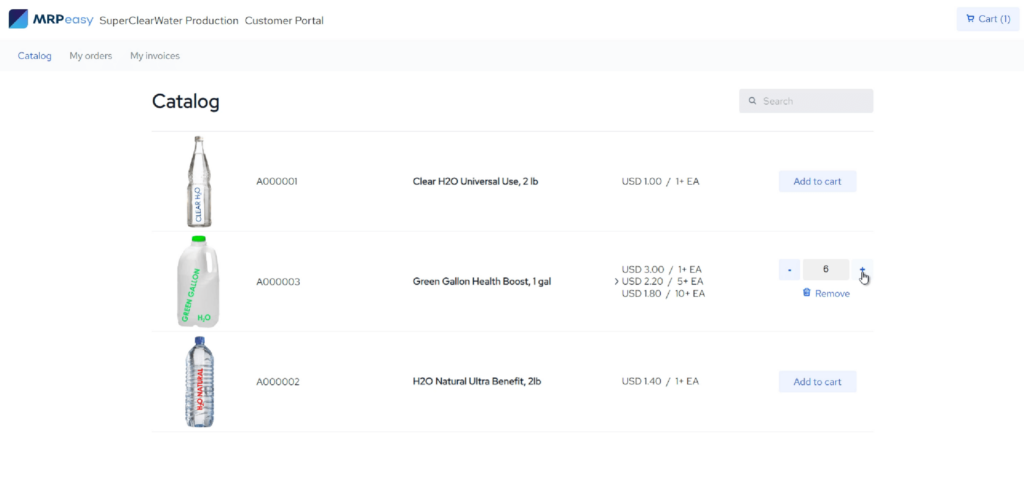
For you, MRPeasy’s B2B Customer Portal enables:
- Inviting customers to the portal directly from the CRM.
- Revoking customer access when needed.
- Controlling product visibility based on the price list assigned to each customer.
- Displaying prices in the currency assigned to the customer.
- Receiving portal orders in MRPeasy’s CRM in Confirmed status.
- Notifying the customer’s account manager when a portal order is placed.
- Processing portal orders in MRPeasy’s CRM like other customer orders.
- Showing customers order statuses, estimated shipping dates, tracking numbers, invoices, and shipment information when these details have been entered or created in MRPeasy.
For your customers, the B2B portal enables:
- Browsing the Catalog page and adding available products to the cart.
- Seeing products based on the price list assigned to them, or the default list of items with selling prices if no specific price list is assigned.
- Reviewing and placing orders through the Cart page.
- Selecting a shipping address from the addresses already defined in their customer details in MRPeasy CRM.
- Using “Pickup at Vendor’s location” if no saved shipping address is available.
- Viewing all visible customer orders on the My Orders page.
- Opening order details and using “Order again” to refill the cart with the same items.
- Monitoring order statuses, dates, and tracking numbers.
- Accessing invoices on the My Invoices page once invoices have been created in MRPeasy CRM.
- Opening invoice details and downloading invoice PDFs.
- Viewing payment information once an invoice has been created.
- Viewing shipment information once a shipment has been created in MRPeasy CRM.
Visit our knowledge base for a complete overview of MRPeasy’s customer portal functionality.
Key takeaways
- A B2B customer portal gives business customers a self-service interface for placing orders, reordering products, tracking order progress, and accessing invoices.
- For manufacturers and distributors, customer portals are most valuable when connected to CRM, ERP, inventory, and production workflows, allowing customer orders to move into the operational system with less manual handling.
- Unlike a standard web store, a B2B customer portal is built around ongoing customer relationships, customer-specific pricing, custom product catalogs, order history, invoice access, and order status visibility.
- Integrated customer portals reduce administrative work by minimizing manual order entry, repetitive status update requests, invoice resending, and other routine customer service tasks.
- For SMB manufacturers and distributors, a B2B customer portal can improve customer experience, support repeat sales, reduce order processing errors, and make it easier to scale sales without adding unnecessary admin work.
Frequently asked questions
A customer portal is worth considering when the company handles repeat orders, uses customer-specific price lists, receives frequent order status requests, or wants to reduce manual order entry and customer service workload.
Integrating a B2B customer portal with an existing CRM or MRP system can present challenges as aligning the software often requires technical knowledge, API access, or using third-party workflow automation software. A practical alternative is to choose a production or inventory management software with a built-in customer portal. This central hub ensures seamless operation and data synchronization across all business processes.
A B2B customer portal enables personalized experiences and transparent access to real-time order tracking and account information. This builds trust and reliability, making customers feel more valued. Access to historical data also simplifies reordering, simplifying the ordering process for recurring customers.
By automating parts of order management, a B2B customer portal reduces manual errors and speeds up the ordering process. It provides real-time updates on order status from placement to delivery, reducing customer support inquiries and enabling better planning for both customers and businesses.
A manufacturing customer portal is a B2B customer portal designed for manufacturers, allowing customers to place orders, reorder products, track order progress, access invoices, and view shipment information through a controlled self-service interface.
You may also like: Sales Forecasting in Manufacturing – A Guide for SMBs
Get manufacturing know-how delivered to your inbox!