Returns Management – Tips and Tools for SMEs
A proactive stance on product returns is an essential aspect of modern trade, as relevant for retailers as it is for wholesalers, distributors, and manufacturers. In this blog post, we look at what a modern returns system should include and provide tips for SMEs.

What is product returns management?
Product returns management is the process of organizing all aspects related to returning goods from the end customer for any reason. It addresses internal topics, such as how to handle returns, creating a returns policy, and the fate of returned items, as well as customer-facing topics, including reimbursement & replacement, communication, and the overall return experience.
Companies rely on different methods to handle their returns – retailers and distributors often employ dedicated Returns Management Systems, whereas white-label manufacturers might make do with a returns functionality built into their order management software or even a spreadsheet to keep track of returns.
One thing is for certain – modern customers expect a product returns option, and in most sectors, it’s also a legal requirement, especially for e-commerce companies.
Returns management vs. reverse logistics vs. RMA?
Returns management relies on a subset of supply chain management called reverse logistics. The terms are sometimes used interchangeably, but they aren’t exactly the same thing. Another term often confused with returns management is RMA.
- Return Merchandise Authorization (RMA) refers to a specific return case initiated by a customer with a company. Once accepted by the company, return cases are often issued a tracking number, referred to as an RMA code, and follow internal coordination according to the returns policy. But many still use “RMA” to refer to the entire returns process.
- Returns management is about everything that concerns the customer and the supplier in the handling of product returns, from communication and terms to return costs and customer satisfaction. It includes RMAs, but has a broader scope.
- Reverse logistics is a supply chain management process that deals with any kind of movement of goods back up the supply chain towards their point of origin. It includes product returns, but also item disposal, subcontracting logistics, supplier and logistics partner agreements, and other aspects of product lifecycle management.
The importance of returns management for manufacturers and distributors
It’s no understatement that returns management is increasingly important for retailers, distributors, and manufacturers alike. Research reveals that more than 80% of customers will check the returns policy of an online retailer or goods provider before committing to a purchase. Statista further reports that almost a quarter of all online purchases made in 2024 resulted in a return process.
The primary reasons for returns include:
- Warranty claims, in case of faulty or defective items or due to damage that occurred during shipping.
- Legal requirements for vendors to accept returns of undamaged and unused items, such as those in the EU, for online purchases.
- Wrong items shipped due to order management or supply chain errors.
- Buyer’s remorse or customers changing their minds for other reasons.
But aside from catering to customer preferences, here’s why thinking through your returns process is essential from a business management perspective.
Operational efficiency
Because accepting returns in at least some form is necessary for almost any goods provider, having an efficient returns system in place is crucial for preventing returns from hampering daily operations.
A well-organized returns process – inspection, processing, and routing of returned goods to their next destination (restocking, repair, or recycling) helps companies maintain good inventory turnover and free up valuable space. This is all the more important during peak seasons, when all departments need to operate at high performance, preventing returns from creating order fulfillment bottlenecks.
Uncertainty regarding who is responsible for processing returns and when also hampers efficiency. Ownership should be assigned to a concrete department or employee, and the work coordinated with all affected departments.
Customer retention and brand reputation
The returns experience of a company is increasingly correlated with customer loyalty and brand perception. Today, buyers expect a hassle-free, transparent, and customer-oriented return policy. This goes for both B2C and B2B businesses.
Perhaps counterintuitively, a customer-oriented returns process actually builds trust and helps boost retention. Recent statistics have shown a clear connection: up to 90% of customers are likely to conduct repeat business with a reseller if the return experience is easy. However, more than 80% of shoppers will not repurchase from a retailer after a poor returns experience.
And yes, this applies to manufacturing and distribution businesses as well, not just to end consumers or intermediaries. If a supplier accepts returns of defective, late, or excess raw material deliveries, manufacturers are more likely to rate their supplier performance better. The reason is simple – a customer-friendly returns policy sends a signal that a company stands behind its products and values its clients beyond the initial sale.
Financial impact
Product returns inevitably cost money for the seller. According to the National Retail Federation, U.S. consumers returned more than 15% of all purchases in 2024, worth almost $900 billion in lost sales, and the trend is clearly on the rise.
For most businesses, returns translate into direct costs (shipping, handling, repackaging, etc.), as well as hidden costs like loss in inventory value. Every return requires labor and resources to process, and this can and will erode gross revenue if not diligently managed.
This means that the efficiency of the returns process can affect a company’s bottom line by a considerable margin. A well-thought-out process can recoup a significant portion of the value as returns optimization – processing speed, prompt repackaging, refurbishment, marketing strategies, etc., helps avoid excessive write-offs and heavy discounts. Statistics show that an optimized returns process can help retain up to 65% of a returned good’s value.
Compliance requirements
Certain sectors are bound by regulations that make returns or take-backs compulsory to ensure safety, quality control, or sustainability. In these cases, returns are not just a customer service policy but a legal requirement, and compliance is a prerequisite for market entry. This trend is especially pronounced in the US, UK, and EU, where regulators continue to expand mandatory return and take-back schemes in pursuit of safer, more sustainable business practices.
Here are a few examples:
- Returning unused or expired medical products and pharmaceuticals is often compulsory under health regulations. Pharmacies in the UK, for instance, are obliged to accept back unwanted medicines from patients for safe disposal. Likewise, hospitals and clinics follow strict protocols to return expired drugs or defective medical devices to manufacturers for proper handling.
- Environmental compliance drives mandatory take-back programs for electronics and e-waste in many regions. The EU’s WEEE Directive requires manufacturers to accept old electronic devices back free of charge and to meet binding e-waste collection and recycling targets. Similarly, about half of the US states enforce e-waste recycling laws where producers must fund or arrange the collection of used electronics. These rules compel businesses to facilitate returns of electronics (for both B2B and B2C) for proper recycling, primarily to incentivise keeping hazardous e-waste out of landfills.
- Consumer protection laws in the EU grant customers an unconditional right to return unused products purchased through e-commerce channels within 14 days, essentially requiring any B2C business in the market to have a returns process.
How to handle product returns?
Let’s take a look at the essential steps for implementing a solid returns process.
Create a return policy
A solid return policy is the basis of an effective returns process. First, you should clearly define the conditions under which you will accept returns. Make sure these comply with local consumer protection laws and any industry-specific regulations. The policy should be easy to understand and readily available (for example, posted on your website and included with deliveries) so that expectations are clear before any purchase is made. A return policy works twofold: it builds trust with customers and provides your team with a clear plan for handling return requests.
Make sure that your policy covers the following:
- Return window: The time period during which customers can return a product (e.g., within 30 days of delivery).
- Item condition: The required condition for accepting returns, and instances in which opened or used items are eligible, like defective or damaged items, incorrect shipments, buyer’s remorse, etc.
- Return process: How to initiate a return (such as contacting support or submitting an online RMA form) and the need for authorization before sending items back. More on that below.
- Refund or exchange terms: What the offered resolutions are (refund, replacement, store credit), and under what conditions are they provided. Also, clarify who covers return shipping costs and whether any restocking fees apply.
Initiating returns
When a customer decides to return an item, it’s their responsibility to initiate a return request, typically referred to as an RMA. It should be easy to do this, either through an online return portal, a form on your website, or contacting your customer service. Essentially, return authorization is making sure that both parties are aligned with the return.
After receiving the RMA claim, your job is to verify its credibility and then issue an RMA number or code to the customer. Make sure to provide clear instructions on how to send the product back, like proper packaging, the return address, and any shipping labels or other required paperwork. This helps avoid lost packages or unidentified items in your warehouse later.
If your integrated ERP or CRM has built-in return management features, this step can be partly automated through features like converting cases into internal return orders, assigning RMA numbers, recording return details, and even emailing customer confirmations. This simplifies your end of the process, allowing the warehouse, customer support, and accounting teams to minimize human error and efficiently handle their respective roles.
Receipt of returns and inspection
It’s essential to be methodical with returned items. Create a designated area and procedure for receiving returns. The team should first identify the item by its RMA number and then proceed with a careful inspection of the product’s condition. The task is to both verify that the returned item matches the authorized one and assess its condition.
Along with the global increase in return cases, return fraud is also on the rise. So make sure that the product is eligible for return under your policy and hasn’t been altered in any way. You should also note the packaging condition to ensure there wasn’t any shipping damage on the way back. Document these observations in the return order or log. This will be used to determine how you’ll process the return, and it’s also useful for any future analysis or in case of disputes.
After inspection, update the return status and share the findings internally. If the item conforms to the customer’s return reason, the next step is to issue a replacement or refund. However, if it turns out that the item is ineligible for a refund or replacement, the RMA case proceeds to the resolution stage.
In some cases, the manufacturing quality control or engineering team might also be alerted, especially if the return was due to a product defect, as they may want to examine the item to identify any larger production issues.
Return resolution
If the return reason is a confirmed defect or some error on your part, like shipping the wrong item, offer a no-hassle replacement and ship it out to the customer at your expense as quickly as possible. If the customer doesn’t want a replacement or one isn’t available, a prompt refund or credit is the way to go. For example, if the item is out of stock or discontinued. Some scenarios could also call for a repair rather than a replacement, if the product is high-value and can be fixed under warranty.
But if the returned item is ineligible for any of the above, you’ll need to agree on an alternative solution with the customer. Whether the reason is product damage, signs of use, or return conditions not being met, point to the return policy and inspection findings to justify the outcome. In some cases, you might choose to send the item back to the customer, sharing shipping costs as an act of good faith, or offer a partial credit or discount on future purchases.
But, whatever the resolution, act quickly and keep the customer informed throughout. For a replacement, tell them that a new item is on the way and provide the tracking number and expected delivery date. If issuing a refund, share the time estimate. Clear communication is the foundation of good customer experience and provides a real opportunity for retention.
Refurbish, restock, or dispose
Once the customer’s return is settled, your team needs to decide what to do with the returned product itself. Pristine condition items can often be returned to stock, while others require repackaging, cleaning, repair, or writing off entirely. A standard approach for each scenario helps maximize value recovery and minimize waste.
- Restock: If the product is in brand-new or resalable condition, for example, with an unopened package or barely used with no defects, it can simply be returned to inventory for resale. Ensure that you update your stock counts accordingly and maybe note down that the item was a return, for example, in case the packaging requires a quick check. Reselling offers by far the most effective way to recover revenue.
- Refurbish or repair: If the item isn’t ready to sell as new but has minor defects or can be fixed, route it to repair or refurbishment. A small malfunction can often be repaired in-house or sent to the manufacturer. After fixing, you might resell it as a refurbished product or use it as a loaner, demo unit, or replacement unit in the future. Refurbishing returned products is the next best thing for reducing losses after restocking.
- Disposal: If the returned item is damaged beyond repair, not economically fixable, or not eligible for resale, your only option is to dispose of it and write it off from inventory. This could mean scrapping it for parts, recycling materials where possible, or issuing it to your disposal partner.
Handling the post-return phase also requires coordination and good record-keeping. Make sure your inventory is updated to reflect the returned item’s status. Modern ERP or MRP systems with returns management functionality can help a lot here. They enable marking returns’ status when receiving (back to stock, sent to repair, scrapped, etc.), automatically adjusting your inventory levels, and creating an audit trail.

Best practices for improving returns management
Here are five tips to make your returns strategy bulletproof.
Create a clear returns policy, and communicate it clearly
Effective returns management presumes a well-defined, unambiguous returns policy. First off, it should clearly outline the conditions for returns, like eligible items, acceptable reasons, time limits, and any restocking fees or required paperwork.
Equally important is transparency in communicating the policy. Display it on your website, include it with sales documentation, and definitely train your staff on it. When customers understand the return rules upfront, it sets proper expectations for doing business with you and builds trust.
Transparent sales and good product quality equal fewer returns
No matter how effective your return policy, the best way to handle returns is to reduce how often they happen in the first place. Transparency about your product and sales process can dramatically cut down on returns. Provide accurate, detailed product information, share honest customer feedback, and avoid exaggerating features or capabilities – all this helps customers know exactly what they’re getting, thus reducing return rates.
At the same time, invest in good quality control in your manufacturing or logistics process so that the goods leaving your facility meet promised specifications and are free of defects. Tracking some crucial manufacturing KPIs like First Pass Yield or Scrap Rate can go a long way in uncovering root causes of poor quality and addressing them.
Track returns data and feed insights back into operations
Tracking returned items within your inventory management system can serve as a valuable feedback loop for improving operations and product development. Record key details of your returns like the product type, the reason for return, and any underlying issues.
This might well uncover deep insights into your processes. Perhaps you can update your product design, enhance product descriptions, or adjust your inventory purchasing strategy based on the findings. It’s a highly cost-effective feedback mechanism with the potential to mitigate some of the impact of returns and ultimately lower the average cost of returns.
Involve the customer in the returns process
It bears repeating – returns are a two-sided transaction and should be handled as such. Always engage the customer early on and don’t leave the return claim hanging. Remember, a returns process is a critical junction for customers concerning your brand reputation. Be proactive and ask them what outcome they would prefer or offer a symbolic gesture, such as free return shipping, even if the return is not eligible for a replacement or refund.
The point is, by listening and reacting to the customer’s needs and expectations, you make them feel valued, turning a potentially negative experience into a positive encounter. Also, use this opportunity for honest feedback about issues or gaps in your service – encourage customers to share the reason they are returning the product if it’s not already clear.
Standardize your returns workflow
A structured workflow makes returns a part of your operation, not its disruptors.
Consider the following when sculpting or upgrading your process:
- Use a return merchandise authorization (RMA) system, whether a stand-alone software or integrated with your inventory or production software. This can automate tasks such as assigning unique RMA numbers, tracking returns, and updating your inventory records to minimize processing times.
- Connect your returns flow directly to your online store through an API or webhook integration. This enables customers to initiate returns independently from their e-commerce account page, while reducing manual handling and unnecessary back-and-forth for your team.
- Make sure that all relevant teams, like customer service, inventory, accounting, etc., are informed and trained on the procedure and their role in it. If everyone follows the same rules, the returns process becomes faster, more predictable, and less prone to errors.
Digital tools for a smoother returns management process
Digital tools can drastically reduce the manual workload of processing RMAs and provide invaluable traceability on product returns. Here are three options to consider for your returns management solution.
Spreadsheets – basic digital return tracking
For microbusinesses or those just starting out, a spreadsheet app can serve as a makeshift returns management tool. This can be useful for logging RMA numbers, product details, return reasons, and status updates in a structured table. A spreadsheet has the advantage of being low-cost and familiar – anyone can customize it to track basic return information and share it with the team with minimal training. It’s a quick way to get started without investing in specialized software or change management.
But managing returns like this becomes tedious as volumes grow because the spreadsheet is disconnected from the rest of your order management system. Each return must be entered and updated by hand, which is time-consuming and error-prone. So while it may work for a low number of returns, it’s generally not scalable. Spreadsheets lack automation and real-time updates, meaning it’s easy to miss a step or lose track of a product in the return pipeline.
Returns Management Systems – full automation for retailers and distributors
A dedicated Returns Management System (RMS) is purpose-built software that automates and streamlines the entire returns process. These platforms typically provide a self-service portal for customers to initiate returns, generate RMA numbers and return shipping labels automatically, and keep both the customer and the company updated on the return status. A good RMS will automate return approvals, track returned products, integrate with shipping carriers, and provide analytics to identify patterns. In other words, it’s designed to cover reverse logistics with minimal manual intervention.
RMS solutions are useful for retailers and e-commerce businesses that handle high volumes of returns. E-commerce sellers, for instance, often face return rates up to 30% of orders, managing which via spreadsheets or email would be a giant hindrance to operational efficiency. An RMS can absorb this complexity by applying business rules (for example, automatically approving returns that meet policy criteria), coordinating logistics, and even detecting fraud. Industry experts suggest that any retailer with a return rate of over 10% should seriously consider an RMS to maximize ROI.
Production software with integrated RMA functionality
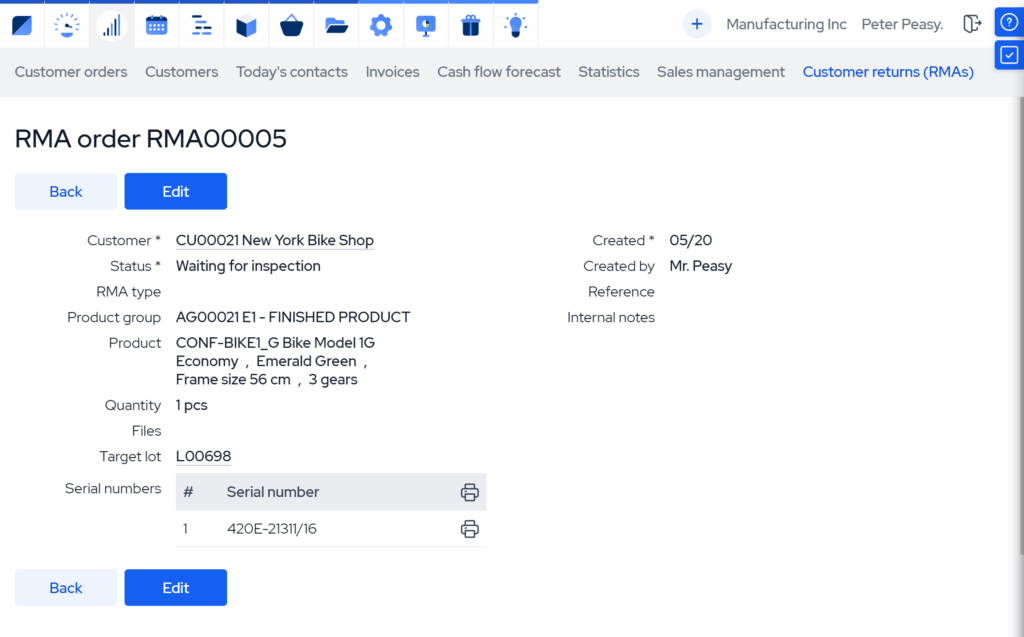
For manufacturers or SMEs that want returns management directly integrated into their inventory and production processes, using an ERP system with a built-in RMA module is perhaps the best option. Unlike standalone RMS platforms, an integrated production planning system handles returns as part of the overall business workflow. Returns are directly linked to production planning, inventory control, and quality inspections. When a product is returned, the system records the return, automatically updates stock levels, quarantines the returned item, triggers a quality inspection, and prompts next steps, such as repair or replacement.
For example, MRPeasy’s Built-in RMA feature lets users handle the entire return cycle within their manufacturing ERP ecosystem. It enables logging a customer’s return request, receiving the item into stock for inspection, and deciding on the resolution – whether it’s a refund, sending a replacement, or scheduling a repair. MRPeasy tracks each returned item through inspection and service, automatically updates its status at each stage, and issues return labels for return shipping. For items requiring rework, MRPeasy can generate a service order to manage the repair process, recording the labor and materials used, and scheduling the task in the production calendar. Once resolved – a replacement shipped out or a refund issued – the inventory is adjusted and the RMA is closed, all without leaving the platform.
Key takeaways
- Product returns management is the process of handling customer returns, from policy to processing, including communication, refunds, replacements, and final item disposition.
- A clearly written, compliant, and accessible returns policy prevents confusion, reduces disputes, and sets the tone for a professional returns process.
- Good product information and quality control are the best tools for preventing avoidable returns. Accurate descriptions and reliable quality help ensure customers receive what they expect the first time.
- Every return contains operational insight. Tracking returns data by product, reason, and outcome helps uncover recurring issues and supports continuous improvements in design, quality, and fulfillment.
- Some industries and markets require return processes by law. Sectors like pharma, electronics, and e-commerce face specific compliance obligations that affect how returns must be handled.
- A standardized return workflow increases speed, consistency, and accountability across departments. When everyone knows the process, returns stop being a disruption and start being just another well-managed workflow.
- Digital tools, from spreadsheets to RMS or integrated ERP systems, help streamline the returns process. The right choice depends on your size, return volume, and how tightly returns need to connect with production or inventory workflows.
Frequently asked questions (FAQ)
Returns management software is a digital tool that helps companies handle product returns efficiently. It can be an integrated part of a larger ERP system or standalone software. It tracks return requests, issues RMA numbers, and manages inspections and resolutions. Integrated solutions further update inventories and help schedule return-related operations. Returns software simplifies the workflow across departments, improving accuracy and speeding up the returns process.
Reverse logistics refers to the movement of goods back through the supply chain, typically from the customer to the seller. Returns management is the structured process of handling returned products, including authorization, transportation, inspection, and resolution. It’s a key part of reverse logistics, but the former encompasses more than just returns.
Best practices for improving returns management include setting a clear return policy, maintaining high product quality, and involving the customer in the process. Tracking return data helps identify patterns, while standardized workflows and internal coordination ensure returns are handled quickly and accurately.
Companies can cut return costs by reducing avoidable returns through better product information and quality control. Streamlining the returns process, refurbishing items when possible, and using the right digital tools also help recover value and minimize losses. Prevention and efficiency are key.
You might also like: How a B2B2C Model Expands Your Market Footprint
Get manufacturing know-how delivered to your inbox!