Job Order Costing – Achieving Accurate Margins in the Job Shop
Job order costing tracks the materials, labor, and overhead of each individual job instead of averaging them across production. For make-to-order manufacturing business owners, it’s the difference between quoting a job profitably and eroding profit without realizing it.
What is job order costing?
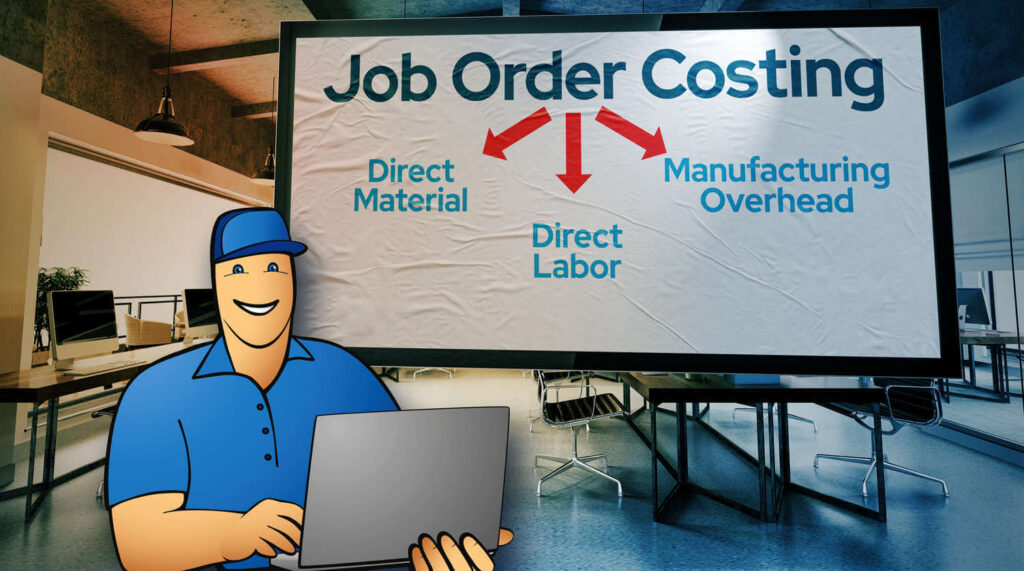
Job order costing is a method for calculating the total cost of a single job or customer order. You tally up the direct materials, direct labor, and manufacturing overhead that go into that one job, rather than spreading costs across a whole production run. It’s how job shops and make-to-order manufacturers cost work when no two orders are alike.
The reason comes down to variety. When a shop turns out custom-made or low-volume products, every job draws on a different mix of materials, labor, and machine time – so a single average cost would tell you almost nothing about any one order.
Job order costing answers that by treating each job as its own cost object. Mass producers running thousands of identical units face the opposite situation, which is why they average costs across the run instead.
The importance of accurate job costing
Inaccurate costing is dangerous because it’s invisible. The wrong cost looks exactly like the right one, so a shop can easily underprice every job, stay busy, and feel profitable right up until the cash runs short.
Accurate costing matters on three fronts:
- Pricing. Bid too high, and you lose the work; too low, and you win jobs that lose money.
- Profitability. Only real cost data shows which jobs and customers pay and which cost more than they bring in.
- Decisions. What to chase, what to drop, and where to invest all rest on costs you can trust.
When to use job order costing (and when not)
How do you know job order costing fits your shop? A few signals make it the right call:
- Orders are unique or custom-made to each customer rather than identical.
- Production runs in small batches or one-offs instead of high volume.
- Work follows a make-to-order or assemble-to-order model.
- A job kicks off because a customer order comes in, not because a forecast says to build stock.
It’s the wrong tool for the opposite case. Manufacturers running continuous or mass production of identical units gain nothing from costing each one separately – process costing, which averages costs across the run, is the better fit there.
In practice, job order costing shows up wherever work is built to order. Common examples include:
- Machine shops and custom metal fabricators.
- Cabinet and furniture makers that create customized products.
- Builders of bespoke equipment and machinery.
- Contract manufacturers handling varied client specs or unique products..
The job order costing formula and its cost elements
Every job’s cost comes down to one formula:
Total job cost = direct materials + direct labor + manufacturing overhead
The first two are traced directly to the job: the materials it consumes and the hours spent building it. The third, manufacturing overhead, has to be estimated and applied, since it can’t be measured per job the way materials and labor can.
Direct materials
Direct materials are the raw materials and components that go directly into a job’s finished product and appear on its bill of materials. They’re used in measurable quantities, so they trace straight to the specific job.
Not everything physical makes the cut, though:
- Direct materials: the wood, steel, and upholstery in a custom table.
- Indirect materials: the glue, screws, and sandpaper, which are too small to track per job and roll into overhead.
Direct labor
Direct labor is the cost of the people who build the job: the hours your welders, machinists, and assemblers put into it. Because you log those hours against the specific job, they’re simple to trace.
Here too, direct and indirect split apart:
- Direct labor costs: the operator running the part, the welder joining it, the assembler finishing it.
- Indirect labor costs: supervisors, schedulers, QA, and maintenance, whose time supports many jobs and lands in overhead.
Direct labor is more than the hourly wage, though. Benefits, payroll taxes, and overtime can push the true cost well above it, and a job that leaves them out comes in undercosted.
Manufacturing overhead
Manufacturing overhead is everything else it takes to run production — the costs that aren’t direct materials or direct labor but still belong to building the job. It typically includes:
- Indirect materials and indirect labor.
- Rent, utilities, and insurance for the shop floor.
- Equipment depreciation and maintenance.
- Property taxes and other facility costs.
Here’s the catch: overhead can’t be traced to a single job the way materials and labor can. It’s shared across everything the shop produces, so it has to be allocated. How you allocate it is the subject of the next section.

Costing methods: how overhead gets allocated
With materials and labor already traced, the choice of costing method comes down to one thing: how you handle overhead. Job order costing uses three approaches — actual costing, normal costing, and activity-based costing (ABC) — and each applies overhead to the job differently. We’ll take them in turn.
Actual costing
Actual costing uses the real overhead a job incurs rather than an estimate. That makes it accurate but slow: actual overhead isn’t known until the job is finished and the period’s books close, so it can’t be used to quote. In practice, it’s a reconciliation tool, not a pricing one.
Normal costing and the predetermined overhead rate
Normal costing solves actual costing’s timing problem by estimating overhead instead of waiting for it. It applies a predetermined overhead rate – a figure set in advance from historical overhead costs and an allocation base, usually direct labor hours or machine hours.
Because the rate is ready before the job starts, you can apply overhead the moment you quote, then refine it as actual costs come in. That practicality is why normal costing is the everyday standard in most job shops.
The calculation takes two steps. Start with the rate. Say your shop’s overhead runs $18,000 a month while your team logs 1,200 production hours. Divide one by the other:
Overhead rate = total overhead ÷ total direct labor hours
$18,000 ÷ 1,200 hours = $15 per labor hour
Now apply it to a job. A customer orders 60 custom steel workbenches, estimated at 160 direct labor hours:
Overhead applied = job labor hours × overhead rate
160 hours × $15 = $2,400
Add the job’s direct costs — $6,000 in materials and $4,000 in labor — and the order totals $12,400. That’s the figure we’ll carry through the rest of this guide.
Activity-based costing
Activity-based costing (ABC) goes more granular. Instead of one blanket rate, it splits overhead into separate activity pools – purchasing, production planning, inventory handling, and so on – and gives each its own rate, calculated by dividing that pool’s overhead by its hours. A job is then charged only for the activities it actually uses.
Run the same 60-workbench order through ABC, and the overhead lands differently:
- Direct labor: 160 hrs × $5 = $800.
- Admin: 30 hrs × $8 = $240.
- Purchasing: 10 hrs × $8.30 = $83.
- Production planning: 10 hrs × $8.30 = $83.
- Inventory handling: 15 hrs × $14.70 = $220.50.
That comes to $1,426.50 in overhead, versus $2,400 under normal costing. ABC isn’t cheaper, though – the shop’s total overhead is the same. The ABC job order costing system just aims each cost at the job that drives it, so this support-light job drops while a support-heavy one would rise.
That accuracy takes far more tracking to maintain, so most shops save ABC for jobs where overhead is large or varies a lot between them.
No matter which method you use, remember that the overhead number is an estimate, not a measurement. How good that estimate is decides whether your margins hold up.
The job cost sheet: tracking a job through the books
A job cost sheet is the running record of everything a single job costs. It gathers that job’s direct materials, direct labor, and applied overhead in one place, each entry tagged to a unique job number so costs never blur together across orders.
Costs land on the sheet as the job moves through the shop:
- A materials requisition pulls raw materials from stock onto the job.
- Direct labor hours post against the job as the work gets done.
- Overhead is applied using the rate from your chosen method.
While the job is on the floor, those costs sit in work-in-process. When it’s finished, they shift to finished goods, and when it ships, to cost of goods sold.
The sheet earns its keep at the finish line. The workbench order was quoted at $12,400; once complete, the sheet shows what it truly cost. Comparing the estimate to the actual exposes the variance – where the quote missed – so the next job gets priced more sharply. Tracked one job at a time, those comparisons turn costing from paperwork into a feedback loop.
Job order costing in 6 steps
Every job, whatever the product, runs through the same six steps:
- Identify the cost object. The cost object is the job itself. Assign it a job number that every later cost will reference.
- Track direct materials. As materials leave stock for the job, a materials requisition records them against it.
- Track direct labor. Capture the hours worked on the job, costed at the full labor rate rather than base wages alone.
- Estimate and pool overhead. Total your indirect production costs and set a rate using actual, normal, or activity-based costing.
- Allocate overhead. Apply that rate to charge the job its fair share.
- Total the cost. Sum the three components for the job’s complete cost.
Job order costing vs. other costing methods
Job order costing is one approach to product costing — the broader practice of assigning production costs to what you make. The main alternative is process costing, but there’s also a hybrid method sitting between them. Let’s look at both.
Process costing
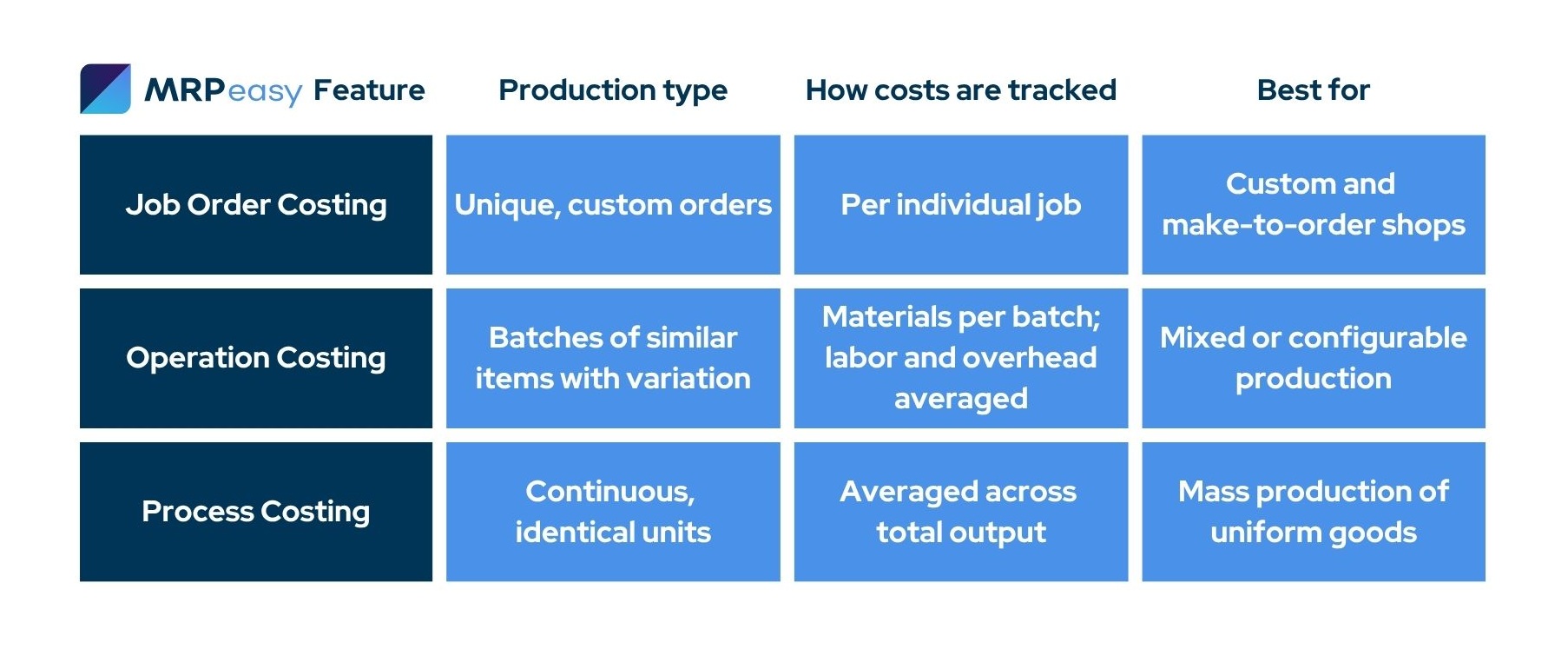
Process costing is the opposite approach to job costing. It averages production costs across a continuous run of identical units rather than tracking them job by job. A plant making thousands of identical fasteners has no reason to cost each one separately, so it spreads total costs over total output to find an average cost per unit.
The dividing line is simple. Use job order costing when orders are unique and costs vary between them; use process costing when output is uniform and one unit is indistinguishable from the next.
Continue reading about process costing.
Operation (hybrid) costing
Operation costing, also called hybrid costing, suits shops that make batches of similar products with some variation — for example, a manufacturer running standard frames through the same process but finishing them differently per order, via a configurable BOM. Effectively, it’s an in-between approach.
Materials are tracked per batch, the way job order costing does, while labor and overhead are averaged across the run, the way process costing does. It’s the middle ground for work that’s neither fully custom nor fully standardized.
Pros and cons of job order costing
Job order costing earns its accuracy through detail, and that detail is also its main cost. The benefits and limitations below trace back to the same trade-off.
Benefits of job order costing
The payoff for all that detail is control. Job order costing gives a custom shop:
- Accurate quotes. Knowing a job’s true cost lets you price it to protect margin instead of guessing.
- Per-job profitability. You can see exactly which jobs made money and which only looked like they did.
- Efficiency insight. Cost data flags where labor, materials, or machine time ran over.
- Sharper future bids. Real cost history turns each completed job into a better estimate for the next.
Limitations of job order costing
Those gains come at a price. Job order costing’s drawbacks are real:
- Heavy on admin. You’re tracking materials, labor, and overhead on every single job, and that takes both time and discipline.
- Overhead stays an estimate. The predetermined rate is a forecast, so a job’s overhead can be off until the actuals come in.
- Error-prone by hand. Done on spreadsheets, all that per-job detail gets harder to keep accurate as the work piles up.
- Wrong fit for volume. For high-volume runs of identical units, per-job tracking adds work without adding insight.
Tips for increasing costing accuracy in your shop
Keeping job order costing accurate comes down to a handful of habits. Here are four worth building into every job:
- Track real shop-floor data. Capture actual labor hours and material usage against each job, so your costs reflect what happened, not what you guessed. A material swap mid-run or an hour of rework nobody logged is exactly the kind of thing that slips past an estimate and quietly eats your margin
- Revisit your overhead rate. When material costs climb or your job mix changes, recalculate your predetermined rate. The one you set six months ago is probably already off, and every quote you send in the meantime inherits that error.
- Cost the full picture. Fold in labor burden and indirect costs so the quote reflects what the job truly costs. Leave the burden out and a job can read as profitable on the quote while it loses money on the floor.
- Close the loop. Compare every estimate to its actual cost and feed the difference into your next quote. That gap is the most honest feedback a shop gets, and running enough jobs through it sharpens your quoting every time.
Each of these is simple in principle. The challenge is doing them consistently on every job while the shop is running, which is hard to sustain in spreadsheets as the work piles up.
How MRP software improves job order costing
Every one of the above habits comes down to keeping up on every job while the shop is busy. Manufacturing software is what makes that sustainable.
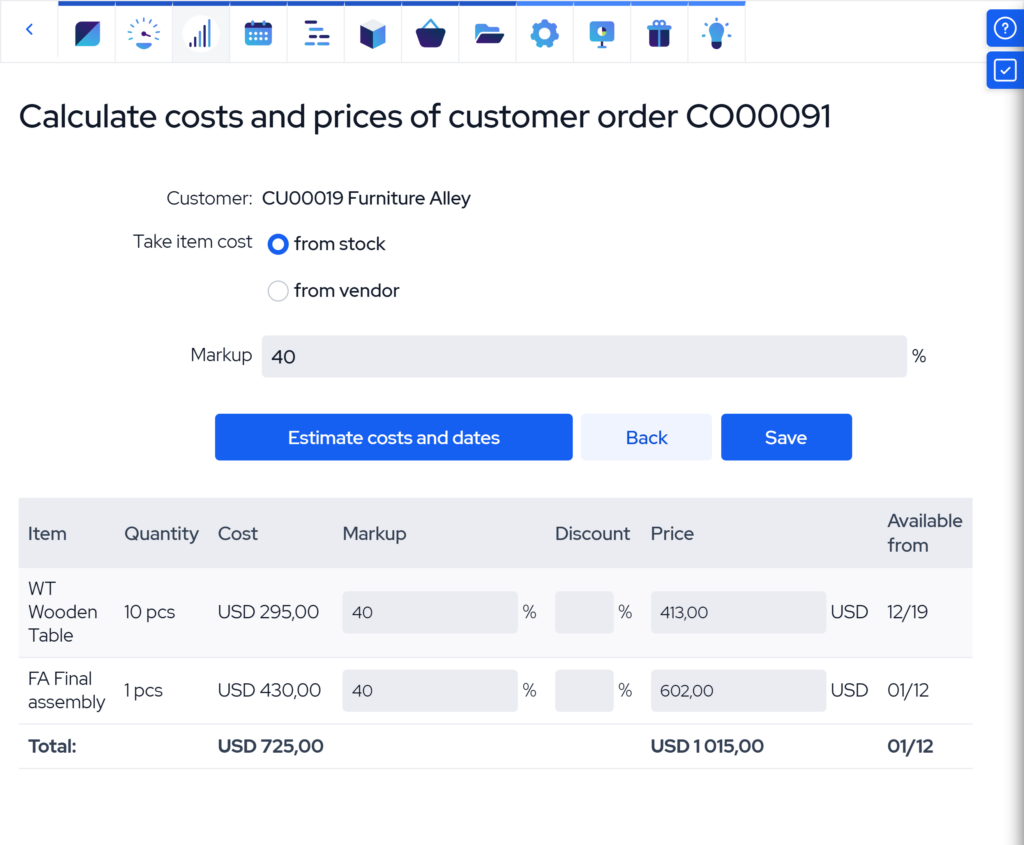
Think back to the job cost sheet. A manufacturing ERP keeps those same records, but it does it automatically. Materials, labor, and overhead are all posted to each job as production happens, so a job’s cost is always current rather than pieced together after the fact. Quote and actual stay visible together, and the gap between them never goes stale.
At the core of this kind of sync are the bills of materials that are intricately tied to everything from sales to production planning, purchasing, and finances, allowing you to calculate material requirements, estimated lead times, and job order costs, while also creating accurate production schedules – all with just a few clicks.
The payoff is timing. You stop learning whether a job was profitable after it’s gone, and start seeing it while you can still do something about it. For a growing shop, that’s what keeps job order costing accurate at scale. And accurate costing is what keeps margins where they belong.
Key takeaways
- Job order costing is a method for tracking the materials, labor, and overhead of each individual job or customer order. It’s especially useful for custom, make-to-order, and low-volume manufacturers where every order is different.
- Accurate job costing helps manufacturers protect margins before, during, and after production. Without reliable cost data, a shop can stay busy while unknowingly underpricing work.
- The basic job order costing formula is direct materials plus direct labor plus manufacturing overhead. Materials and labor can usually be traced directly to the job, while overhead must be estimated and allocated using a consistent method.
- Overhead allocation is one of the most important parts of job order costing. Most shops use a predetermined overhead rate, while more complex operations may use activity-based costing for greater accuracy.
- A job cost sheet keeps all job-related costs in one place, from material issues and labor hours to applied overhead. Comparing estimated and actual costs helps manufacturers improve future quotes and identify where margins were lost.
- Manufacturing ERP software makes job order costing easier to maintain as the shop grows. By connecting quotes, BOMs, inventory, labor, production, and actual costs, it helps manufacturers keep job costs current without relying on manual spreadsheets.
Frequently asked questions (FAQ)
Job order costing tracks costs for each individual job, while process costing averages them across a continuous run of identical units. The first suits custom, low-volume work; the second suits high-volume production of identical goods.
The predetermined overhead rate is an estimate of overhead per unit of an allocation base, set before production starts. You calculate it by dividing expected total overhead by the expected total of that base, such as direct labor hours or machine hours.
Essential job costing is straightforward: add together the job’s direct materials, direct labor, and applied manufacturing overhead. Materials and labor come from what the job actually uses; overhead is applied with a predetermined rate, since it can’t be traced to a single job.
Yes. Properly set up manufacturing software can capture materials, labor, and overhead against each job as production happens, so job costs stay current without manual tracking. That keeps estimates and actuals aligned in real time and removes most of the admin work.
You may also like: Production Costs – A Simple Guide
Get manufacturing know-how delivered to your inbox!