Automotive Manufacturer Manages 6,000 SKUs with Self-Implemented ERP System
Australian automotive canopy and tray manufacturer Trig Point self-implemented an ERP system in just three months and gained control over its unwieldy component inventory, product customizations, and production processes. “We wouldn’t be able to manage that without a system like this,” says Chris Wasylkiw, Production Engineer.

Company: Trig Point
Industry: Automotive
Product: 4WD chassis-mount canopies and trays
Location: Rowville, Victoria, Australia
Company size: Around 20 employees
Previous system: Xero and spreadsheets
Pain points: Lack of scalability, insufficient manufacturing inventory and order control, and limited visibility into production processes
Implementation time: Around 3 months, self-implemented
Key functions: Inventory management, BOMs and Matrix BOMs, manufacturing orders, production time tracking, shop floor visibility, variation tracking, Xero integration, and API integrations
Results: Better control over more than 6,000 part numbers across two factories, more accurate quoting, easier product configuration, clearer inventory visibility, and reduced risk of errors, stockouts, and delivery delays
From a personal-use canopy to an established industry player
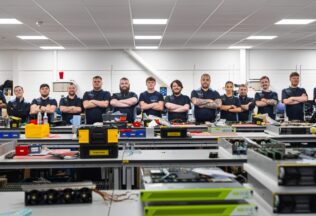
Trig Point is an Australian manufacturer of automotive accessories specializing in chassis-mount canopies and trays for 4-wheel-drive vehicles. The company was started in 2015 by Murray Brookes after a canopy he had made for personal use started attracting interest from friends, colleagues, and fellow 4WD enthusiasts. A few years after the business was established, Chris Wasylkiw, a former colleague of Brookes, joined as a production engineer.
“Murray made his first service body at the place we used to work at,” Wasylkiw details. “So once Trig Point took off, he asked me to join him.”
The company experienced explosive growth during the COVID-19 pandemic. While flights to overseas destinations were disrupted, people still had to quench their thirst for adventure, and for many, 4WD touring was the way to do it. With the spike in demand, Trig Point decided to open its own sheet metal shop next door to its assembly facility to get more control over its production processes. Today, the company is well established in the Australian 4WD community and employs around 20 people.
A manufacturing-centric solution was needed to ensure scalability
When Wasylkiw joined the company, Brookes was still using a combination of Xero and spreadsheets to manage the operation. Both knew, however, that in order to grow, they needed something more scalable. At their previous job, they had used an old DOS-based MRP system, which had highlighted the benefits of a dedicated solution.
“It was ancient, but it still demonstrated how important such a system was to effectively control your stock and orders,” Wasylkiw says. “So we tried to get one as soon as possible.”
Wasylkiw and Brookes laid out their basic requirements: the new system had to be cloud-based, integrate with Xero, and have robust manufacturing inventory management functionality. Looking through the Xero App Store, they found that many inventory management solutions were geared towards e-commerce businesses rather than serious manufacturers.
“Then we came upon MRPeasy,” Wasylkiw says. “As a production engineer, I thought it had all the features we needed.”
Self-implementing the software in just three months
After a free trial of the software, the team felt confident enough to implement it on their own. While much of the data could be imported via CSV files, the bills of materials of the products had to be created from scratch, which took up most of the deployment process. Once the foundation was laid, however, it was easy to add layers of functionality as the managers saw fit. All in all, the implementation took around three months.
“We started with the base package and upgraded as we went along and discovered new things we wanted the software to do,” Wasylkiw says.
Even though the team had built up the bills of materials of the products, initially, they left most of the actual manufacturing features unused. With the opening of the new fabrication shop, they realized that they wanted more control over the processes – to track manufacturing orders, measure production times, and have more visibility into what’s happening on the shop floor.
“We’re also using MRPeasy’s API to create custom apps for dashboards and weekly overviews,” Wasylkiw says.
Managing customizations and more than 6,000 part numbers
After implementing MRPeasy, Trig Point gained far better control over its products and component inventory. The new system proved to be capable of supporting the company as it expanded its product range, increased customization options, and added more part numbers across two factories.
“We’ve got over 6,000 part numbers in our system now,” Wasylkiw says. “We wouldn’t be able to manage that without a system like this.”
MRPeasy has also made quoting more accurate and product configuration easier to manage. As Trig Point expanded its customization offerings, the system gave the team a better way to handle multiple options without relying on manual notes and checks.
“We recently started using the matrix BOM features, so now we can have drop-down menus for building a product,” Wasylkiw says. “There’s the base product that we add customization options to, which makes the quoting and order generation processes a lot easier.”
Better inventory visibility has reduced the risk of errors, stockouts, and delays in deliveries. By tracking stock more accurately, including part variations like colors, Trig Point can respond with more confidence and avoid situations where the system says an item is available, but the wrong version is actually on the shelf.
“Before MRPeasy, our system said we had 10 units, but you go look on the shelf, and they’re all 10 in different colors,” Wasylkiw says. “That variation tracking was one of the first things we added, because it made what stock we had much clearer.”
Suggestions for other small manufacturers
To other small manufacturers struggling with spreadsheets, Wasylkiw suggests taking software adoption seriously. According to him, it is necessary to try to adapt your processes to the software, not vice versa.
“Do it how the software is doing it because it just seems to flow better than trying to force the software to do a round block through a square hole sort of thing,” he says. “And have someone in the company dedicated to the software that users can go to with questions and issues.”
Wasylkiw also praised MRPeasy’s support, saying the ticketing system worked well for an Australian business, while feedback often led to future product improvements.
“If there is something the software does not do, tell MRPeasy support about it – they’ve added several features that we have asked for,” he says.
You may also like: Industrial Control Systems Manufacturer Eliminates Stockouts and Overstocking
Get manufacturing know-how delivered to your inbox!