Inventory Valuation Methods – Finding the Right Approach for Small Manufacturers
Inventory is an asset, but knowing its worth is not always as simple as multiplying the number of units in stock by their purchase price. Especially in manufacturing, where materials are bought at different prices and combined with labor and overhead. Proper inventory valuation addresses this.

- Inventory valuation methods are accounting approaches used to assign costs to inventory and cost of goods sold (COGS). The four main methods are First-In, First-Out (FIFO), Last-In, First-Out (LIFO), weighted average cost (WAC), and specific identification (SI).
- For manufacturers, inventory value includes more than the purchase price of materials. Costs can accumulate as raw materials move through work in process (WIP) and become finished goods, including direct labor and manufacturing overhead.
- FIFO, LIFO, and WAC are primarily cost-flow assumptions, not rules for how physical inventory must move. Physical stock may instead be issued according to expiry dates, lot requirements, warehouse practices, or other operational needs.
- Each valuation method assigns inventory costs differently. FIFO uses the oldest costs first, LIFO uses the newest, WAC averages the cost of similar inventory, and specific identification tracks the actual cost of an identifiable item or lot.
- Your inventory valuation method directly affects COGS, ending inventory, gross profit, and reported profit. When input prices change significantly, different methods can produce noticeably different financial results even when the same quantities are purchased and sold.
- The best inventory valuation method depends on your accounting rules, inventory, and production model. Consider whether items are interchangeable, how volatile costs are, your traceability requirements, administrative effort, and applicable regulations—LIFO, for example, is not permitted under IFRS.
- Inventory valuation becomes much easier to manage when inventory, production, and accounting data are connected. Manufacturing ERP systems can track material costs through purchasing, WIP, production, finished goods, and COGS, reducing the need to reconstruct inventory values manually.
What is inventory valuation?
Inventory valuation is the accounting process of assigning a monetary value to inventory held by a business. For manufacturers, inventory includes more than just goods between purchase and sale – it’s raw materials awaiting use, components and products currently in production, and finished goods made to stock, awaiting sale.
Inventory valuation determines two important numbers: how much unsold inventory remains on the balance sheet as a current asset out of total goods available for sale, and how much inventory cost is recognized as cost of goods sold (COGS) when products are sold. More on those terms below.
There are different ways to go about this. In this article, we’ll explain the four primary methods used for assigning value to your inventory: First-In, First-Out (FIFO), Last-In, First-Out (LIFO), weighted average cost (WAC), and specific identification (SI). Which method makes sense depends on the type of inventory you carry, how your production works, the accounting standards you follow, and how accurately individual inventory costs can be tracked.
Understanding inventory terminology
Before we go into the different inventory valuation methods, here’s a refresher on what inventory value actually consists of. Inventory costs go beyond the market price of supplies. They also include holding and moving expenditure, overheads, and, for manufacturers, all the costs incurred in turning it into finished products.
Inventory costs typically include:
- the purchase price of raw materials and components,
- freight, import duties, and other directly attributable purchasing costs,
- direct production labor,
- manufacturing overhead,
- everything else required to bring inventory to its current condition and location.
Raw materials, WIP, and finished goods
Within the production process, a heap of value is added to purchases. Manufacturing inventory generally moves through three main stages.
- Raw materials are purchased materials and components that have not yet entered production. Their value is generally based on their acquisition cost, including expenses related to the purchasing process.
- Work in process (WIP) consists of products that have already entered production. Some value-adding work has been done on them, but they aren’t yet finished. Their value includes the materials already consumed, plus labor and manufacturing overhead applied up to that point.
- Finished goods are completed products ready for sale. Their inventory value includes all the costs accumulated during production.
Suppose a manufacturer uses $20 worth of materials to make a product, adds $8 in direct labor, and allocates $4 in manufacturing overhead. The finished product has accumulated $32 in manufacturing costs. Accurately tracking the movement of this value from materials through WIP to finished goods is the main reason why inventory valuation is both more complicated and more important for manufacturers than for most retailers or distributors.
Also, check out our guide on how to allocate manufacturing overhead.
Inventory value, COGS, and gross profit
Inventory valuation directly affects both your balance sheet and your income statement. When inventory is still in stock, its cost remains an asset. Once the finished goods are sold, their inventory cost becomes cost of goods sold.
At the accounting-period level, the relationship can be expressed simply:
Beginning inventory + inventory added − ending inventory = COGS
Gross profit is then:
Sales revenue − COGS = gross profit
This is why two businesses with identical purchases and sales can report different gross profits if they apply different inventory valuation methods. During periods of changing material prices, this difference can become quite substantial.
Read more about manufacturing accounting in our guide.
Cost flow vs. physical inventory flow
A common misconception is that a company’s chosen inventory valuation method also determines the order in which physical items should be picked from the shelf. As you’ll see below, methods like FIFO and LIFO assign inventory value based on the cost differences of similar inventory items, depending on the order in which they were procured (assuming they were purchased at different prices).
For example, when using the FIFO method, accounting assumes that the oldest inventory – the one you procured first- is sold or gets used first. But in reality, this is a cost-flow assumption and doesn’t mean that warehouse workers have to necessarily pick the physically oldest unit when an item of that type is sold or required. FIFO simply designates which inventory costs are assigned to the goods sold or consumed.
This distinction matters a lot because the physical flow of inventory should often be governed by totally different considerations, like expiration dates, batch traceability, quality requirements, warehouse layout, or customer specifications. None of which necessarily matters to accounting.
Periodic vs. perpetual valuation
A final note. Inventory can also be accounted for using either a periodic or perpetual inventory system. These are not separate valuation methods, but different types of systems that determine how often inventory records are updated.
- In a periodic inventory system, inventory balances are calculated at specific intervals, usually using a physical inventory count. COGS is then calculated for the accounting period after the fact.
- A perpetual inventory system continuously records inventory movements as goods are purchased, consumed, produced, adjusted, or sold. The COGS stays accurate throughout the period. Perpetual systems rely on automated inventory management software, although physical counts are also used to reconcile differences and confirm accuracy.
The 4 inventory valuation methods
The four main methods each approach inventory costs differently. To make them easier to compare, we’ll use the same basic example for each:
A manufacturer purchases 300 identical components in three batches:
- 100 units at $10 each;
- 100 units at $12 each;
- 100 units at $15 each.
The total inventory cost is $3,700. The company then consumes (sells or allocates to production) 150 units.
FIFO
First-In, First-Out (FIFO) assumes that the oldest inventory costs are assigned to goods sold or consumed first. The most recently purchased inventory, therefore, remains in stock.
FIFO example
Using our example, the first 150 units consist of:
- 100 units × $10 = $1,000;
- 50 units × $12 = $600.
COGS is therefore $1,600.
The remaining inventory is:
- 50 units × $12 = $600;
- 100 units × $15 = $1,500.
Ending inventory value is $2,100.
When it makes sense
FIFO is widely applicable and is relatively straightforward to understand and administer. It’s especially intuitive for manufacturers dealing with inventory that physically rotates in roughly the same order as it arrives, including materials with limited shelf lives or products where older stock should generally be consumed before newer batches.
It can also work well for manufacturers with stable, predictable purchasing patterns, standardized products, and relatively simple inventory records. For smaller businesses, FIFO is often a practical choice because it’s easy to explain, implement, and reconcile without extensive lot-level cost tracking.
FIFO is permitted under both US GAAP (Generally Accepted Accounting Principles) and IFRS (International Financial Reporting Standards) Accounting Standards.
Watch out for
The purchase price of older stock is often lower than for newer stock as material prices rise. If this is the case, FIFO generally produces lower COGS and higher reported gross profit margins than LIFO under the same conditions.
That doesn’t mean FIFO is inaccurate, but managers should understand that the margins shown in their accounts may be based in part on older input costs rather than today’s replacement costs.
LIFO
Last-In, First-Out (LIFO) assumes that the newest inventory costs are assigned to goods sold or consumed first. It’s the same logic as FIFO, but in reverse. Older inventory costs consequently remain in ending inventory.
LIFO example
Using our example, the youngest 150 units consist of:
- 100 units × $15 = $1,500;
- 50 units × $12 = $600.
COGS becomes $2,100.
Ending inventory consists of:
- 100 units × $10 = $1,000;
- 50 units × $12 = $600.
Ending inventory value is $1,600.
When it makes sense
LIFO can be attractive when input prices are rising because current, higher costs are recognized in COGS sooner. This makes reported margins more closely reflect the costs assigned to sold products as the prices are closer to what the business actually paid for materials and components.
During inflation periods, LIGO can also reduce reported taxable income and lower your overall tax liability because higher recent costs increase COGS. However, the tax effect depends on the company’s jurisdiction and accounting setup, so you shouldn’t treat it as the main reason to choose LIFO.
LIFO remains an accepted method under US GAAP and can also be elected for US tax purposes. It’s most relevant for US-based manufacturers with relatively stable, interchangeable inventory and a clear reason to align reported costs more closely with current purchasing costs.
Watch out for
LIFO is prohibited under the IFRS. If you’re thinking of operating across multiple jurisdictions, you might face additional reporting complexity if LIFO is used for one entity but not another.
LIFO can also leave old inventory costs on the balance sheet for a long time. If inventory later falls below those older layers, a LIFO liquidation may occur. This causes older, lower costs to move into COGS, which can temporarily increase reported profit and make margins less reflective of current costs.
For SMEs, LIFO is therefore a method that should generally be selected together with your accountant rather than simply because it produces a desirable result in a particular year. Consider the reporting framework, tax position, inventory turnover, and ability to maintain the required records before you decide to adopt it.
Check out our VS. article on FIFO & LIFO.
Weighted average cost
The weighted average cost method (WAC) pools together the costs of all similar inventory and calculates an average cost per unit. So, instead of tracking whether the $10, $12, or $15 component was consumed in a job or sold, each component with the same SKU (stock keeping unit) receives the same average cost. The costs of new and old stock are blended together rather than maintained as separate FIFO or LIFO cost layers.
Weighted average cost example
Our 300 components cost a total of $3,700.
Average unit cost is therefore:
$3,700 ÷ 300 = $12.33
For 150 units:
COGS = 150 × $12.33 = approximately $1,850
The remaining 150 units are also valued at approximately $1,850.
In a perpetual inventory system, the average cost is usually recalculated whenever new inventory is received. This is often referred to as a moving weighted average.
When it makes sense
Weighted average costing (WAC) works well when businesses handle large quantities of interchangeable items, where identifying the cost of every individual unit would make little sense. Examples include fasteners, bulk raw materials, chemicals, packaging materials, standard electronic components, and other stock that’s purchased repeatedly.
For manufacturers with frequent purchases at slightly different prices, WAC simplifies administering inventory costing. This can be especially useful for SMEs with high transaction volumes and standardized products, where simplicity and consistency outweigh knowing whether one particular component came from a $10 or $12 purchase batch.
The WAC method also smooths short-term fluctuations in purchase prices, making product costs and margins less volatile from one transaction to the next. WAC is permitted under both US GAAP and IFRS.
Watch out for
The smoothing effect can also be a disadvantage in some situations. If material prices rise or fall sharply, the average inventory cost can respond more slowly than current supplier prices. Managers looking only at accounting costs may therefore underestimate the cost of replenishing inventory or producing the next batch.
WAC can also hide meaningful cost differences between lots. If one batch was purchased at an unusually high price because of expedited freight, tariffs, shortages, or other exceptional costs, averaging hides that difference across the inventory pool, instead of keeping it visible.
For this reason, weighted average costing is usually better suited to genuinely interchangeable stock. It’s less useful when individual batches have wildly different costs, or when the business needs lot-level profitability and traceability.
Specific identification
The specific identification method (SI) simply assigns the actual cost of a particular inventory item to that specific item. No averaging or cost assumption is involved. The business tracks the cost associated with the exact unit, batch, lot, or project that’s ultimately sold or consumed.
Specific identification is the most direct of the four methods: the cost recognized in COGS is the actual recorded cost of the inventory that left the business.
Specific identification example
Suppose a manufacturer builds three custom industrial assemblies, costing:
- Assembly A: $2,000;
- Assembly B: $2,300;
- Assembly C: $2,700.
If Assembly B is sold, the company records $2,300 as COGS. The remaining inventory value is $4,700.
There’s no FIFO or average assumption involved because the exact inventory item is identifiable. In manufacturing, the same principle can be applied at the lot or serial-number level. With sufficient stock traceability, a manufacturer knows that a particular finished machine contains components from specific purchase lots and has accumulated a known amount of labor and allocated production overhead.
When it makes sense
Specific identification is particularly suitable for unique, high-value, customized, serialized, or otherwise individually traceable inventory. Typical examples include custom machinery, engineered-to-order products, specialist equipment, and expensive serialized parts.
SI can also make sense when production costs vary significantly from one job or unit to another. A manufacturer producing ten custom machines may gain far more useful information by knowing the actual cost of each machine than by averaging their costs.
For make-to-order and engineer-to-order manufacturers, this can improve job costing and margin analysis because revenue from an individual customer order can be compared against the specific costs incurred to fulfill it.
Specific identification is allowed under both US GAAP and IFRS. It’s actually required under IFRS’s IAS 2 accounting rule for inventory items that are not ordinarily interchangeable.
Watch out for
The main drawback of this method is the level of recordkeeping required. It presumes the capability to reliably link physical items, lots, or serial numbers to their costs throughout purchasing, storage, production, and sale. This may include not only purchase prices but also landed costs, material consumption, labor, subcontracting, and production overhead.
Specific identification becomes difficult if materials are routinely mixed together, inventory movements are not recorded consistently, or production staff fail to properly maintain lot and serial traceability.
It’s not practical for large quantities of low-value, interchangeable items as tracking their exact costs is unlikely to provide enough additional insight to justify the administrative effort. For this reason, SI tends to work best where the economic value of detailed traceability is high enough to support the extra data requirements.

FIFO vs. LIFO vs. WAC vs. SI compared
The right method to use depends mostly on what type of inventory you’re managing, and less on which calculation looks best on paper.
FIFO vs. LIFO vs. WAC vs. specific identification
| Method | How costs are assigned | Good fit for | Main consideration |
|---|---|---|---|
| FIFO | Oldest costs first | Many manufacturers; rotating or age-sensitive inventory | Can increase reported profit when input costs rise |
| LIFO | Newest costs first | Some US companies, especially with rising input costs | Not permitted under IFRS |
| WAC | Average cost across similar inventory | High-volume, interchangeable materials and products | Can smooth or obscure rapid cost changes |
| Specific identification | Actual cost of each identified item | Custom, high-value, serialized, or unique inventory | Requires detailed cost and traceability records |
Our example also shows how much the choice can affect financial results, even though exactly the same quantity of inventory was purchased and consumed.
How the same inventory produces different results
| FIFO | LIFO | WAC | |
|---|---|---|---|
| Total inventory available | $3,700 | $3,700 | $3,700 |
| COGS for 150 units | $1,600 | $2,100 | $1,850 |
| Ending inventory | $2,100 | $1,600 | $1,850 |
Specific identification cannot be calculated from this example without knowing exactly which individual units were consumed.
How to choose the right inventory valuation method?
There’s no universally best inventory valuation method. A practical choice reflects your business type, inventory management requirements, and accounting needs. Here are six starting points to help you make an informed decision.
1. Accounting requirements and regulations in your markets
Your starting point is knowing which methods you’re actually allowed to use in your jurisdiction. Inventory valuation rules differ depending on the accounting framework and tax jurisdictions where you operate. Businesses reporting under IFRS and US GAAP face different constraints – IFRS does not permit LIFO, while US GAAP permits FIFO, LIFO, weighted average, and specific identification.
More specific tax rules can introduce further requirements, so your final accounting method should always be confirmed with an accountant familiar with the jurisdictions where you’re operating.
2. Consider how your inventory behaves
Are your inventory items interchangeable? If one unit is essentially identical to another, FIFO, LIFO, or weighted-average usually makes more sense than tracking each item’s exact cost. But if products need to be individually distinguishable, customized, serialized, or have materially different costs, specific identification becomes much more useful.
Physical inventory characteristics also play a role in this decision to some degree. Even though physical stock rotation and accounting cost flow are technically separate issues, perishable or age-sensitive materials tend to align better with FIFO.
3. Consider cost trends and financial goals
Think about whether your purchasing costs are volatile and how much it affects your finances and cash flow. During sustained inflation, FIFO, LIFO, and WAC can all produce noticeably different COGS and inventory values. That affects reported gross margin, profit, and potentially taxes.
Management should understand these effects, but a word of caution – valuation methods shouldn’t be switched back and forth simply to produce a preferred financial result year on year. Consistency and your accounting requirements matter more.
4. Consider your traceability constraints
For perfect tracking, specific identification may seem like the natural choice because it uses the actual cost of each individual item. But that precision is useful only if your business can reliably maintain the necessary records and has a meaningful financial reason to do so. If materials move through multiple production stages without consistent lot, batch, or serial tracking, identifying their exact costs can quickly become impractical.
More importantly, don’t introduce extensive traceability simply to justify a high-maintenance costing method. The additional tracking effort should be supported by staff willingness to go the extra mile, and a clear business need like high-value inventory, customer-specific costing, or regulatory requirements.
Check out our essential guide on inventory tracking.
5. Consider your production model
Your production type also affects what level of costing detail is useful. A high-volume make-to-stock manufacturer that produces thousands of identical units has different requirements from an engineer-to-order company that builds 10 customized machines over the course of a quarter.
Batch manufacturers may benefit from tracking costs by lot, while custom manufacturers often need to know what each individual job or product actually cost to make. So your chosen inventory valuation approach should make sense in line with how production is planned and reported.
6. Consider your systems and administrative effort
Finally, ask how difficult the method will be to maintain in practice. A super-precise costing system creates more problems than it provides value if employees fail to keep the underlying data current, and tracking consistency starts slipping.
Plan how your accounting, inventory, and manufacturing system can support the chosen approach, how much and what kind of work is required to maintain them, and whether the process will remain manageable, should your transaction volumes increase or new staff join the team.
For SMEs in particular, a slightly simpler method that can be followed consistently is usually far more useful than a highly detailed system that constantly requires manual intervention.
Why accurate inventory valuation matters
Inventory valuation is not just something for the accountant – it affects everyday management decisions more than you think. If your inventory costs are wrong, your margins are off – you might think that a product is profitable when, in truth, material costs eat into the margin or tie up more cash in inventory than you realize.
For manufacturers, value is constantly moving through the business: from purchased materials to WIP, from WIP to finished goods, and eventually into COGS. The better you track that movement, the clearer picture you get of what the business is actually earning and where money gets tied up.
Financial benefits
The first place where inaccurate valuation shows up is the financial statements. If ending inventory is valued too high, COGS is understated, and profit looks better than it really is. If inventory is valued too low, the opposite happens. This same glitch affects gross margin, taxes, and the value of inventory on your balance sheet.
The practical question is, can I trust the margins I’m looking at? Suppose a material used in one of your products used to cost $10 per unit but now costs $12, a 20% increase. If the COGS you are seeing still reflects mostly older $10 inventory, the product’s reported margin may look healthier than the margin you would actually make when replenishing materials at today’s $12 price.
Understanding your valuation gives you a firmer basis for decision-making. Things like whether selling prices still cover manufacturing costs, which products or jobs are genuinely profitable, whether margins are improving or deteriorating, or how much of your working capital is tied up in inventory. And of course, it also makes your financial reporting more reliable for accountants, regulators, or investors.
Operational benefits
The bigger daily benefit is that good inventory valuation turns your costing data into management information. If you know what materials cost, how much value is held up in WIP, or what your finished goods are really worth, you can ask better questions.
- Material costs rising faster than your selling prices? Renegotiate supplier terms or adjust the selling prices.
- Too much money is sitting in stock? Excess inventory means working capital that cannot be used elsewhere. Work to increase your inventory turnover ratio.
- Some products less profitable than you thought? Better cost data can expose products with healthy revenue but weak margins.
- WIP building up somewhere in production? Rising WIP value can point to production bottlenecks, stretched supplier lead times, or other constraints that make jobs take longer than expected.
The takeaway is simple – better inventory valuation gives you better cost information, which ultimately protects your financial health and leads to better decisions.
Tools for automating inventory valuation
Inventory valuation can be calculated manually, and small companies with periodic inventory systems have been doing it like that for decades. But the process becomes increasingly difficult as the number of products, purchases, and production transactions grows. So the best choice really depends on the complexity of your operation, most of all.
Spreadsheets
Spreadsheets are often the starting point for small businesses. For a company with just a handful of products, few suppliers, regular purchases, and simple inventory flows, a spreadsheet can be perfectly adequate to calculate FIFO layers, weighted averages, COGS, and ending inventory.
The problem is scalability and what happens when more than one person needs to handle it all. As transaction volumes increase, spreadsheets require linearly more manual data entry and reconciliation. Tracking WIP, purchase-cost layers, production consumption, returns, write-offs, and multiple locations will result in large interconnected files that only one or two people fully understand. Without automation, they’ll be stuck as the irreplaceable cog in all your processes.
Even if spreadsheet calculations are correct, keeping purchases, inventory values, COGS, and accounting records synchronized becomes increasingly difficult. This is often the point where many businesses move at least the financial side of inventory valuation into accounting software.
Accounting software
Accounting software like Xero or QuickBooks automates much of the financial side of inventory valuation. It can record purchases, maintain inventory asset and COGS accounts, and produce financial statements without requiring every calculation to be rebuilt manually in some disconnected spreadsheet. Some systems also include basic inventory functionality and can calculate inventory values using methods such as FIFO or weighted average.
For very small distributors or simple product businesses, that may actually be enough. But manufacturing introduces another layer of complexity – materials are consumed into production, value accumulates in the WIP account, labor and overhead may need to be added, and several components can become one finished product.
Most general-purpose accounting software is designed primarily to record the financial results of these activities rather than manage the production processes behind them. So again, as complexity grows, businesses should add dedicated inventory software to the stack or integrate their accounting system with a manufacturing ERP.
Inventory management software
Inventory management software adds many layers that general-purpose accounting systems lack. Its main selling point is the move to a perpetual inventory system. This tracks what inventory you have, where it is, and how it moves through the business automatically.
Depending on the system, it can further record receipts and issues, track batches and serial numbers, manage multiple locations, and perform stock adjustments. Costing information and account sync are then passed to the accounting system automatically instead of being maintained separately.
For distributors and straightforward inventory businesses, that may be enough. But for manufacturers and really anyone who adds any sort of value to their purchases, inventory doesn’t merely arrive and leave. Raw materials and components are transformed into other items, even if only repackaging or kitting.
Manufacturing ERP systems
Once you start transforming inventory, just knowing what came in and what went out is no longer enough. You now need to know what went into each production run, when those runs will finish, how much value was added along the way, and what the finished product actually costs you to make.
This is where manufacturing software outperforms inventory management software. Materials issued to a production order carry their costs into WIP. Labor, subcontracting, and manufacturing overheads are added as production progresses, and when the job is finished, the accumulated costs are recorded using actual production data. Once the products are sold, it can then flow into COGS automatically.
For manufacturers, the main benefit is that you no longer have to reconstruct this chain at the end of the month. Your inventory valuation is built from the same transactions your team already records to purchase materials, run production, receive finished goods, and ship orders. That gives you a much more useful view of the business. Not only live inventory values, but also how much it’s worth at different stages, what individual products or jobs actually cost, and whether the margins still make sense as material and production costs change.
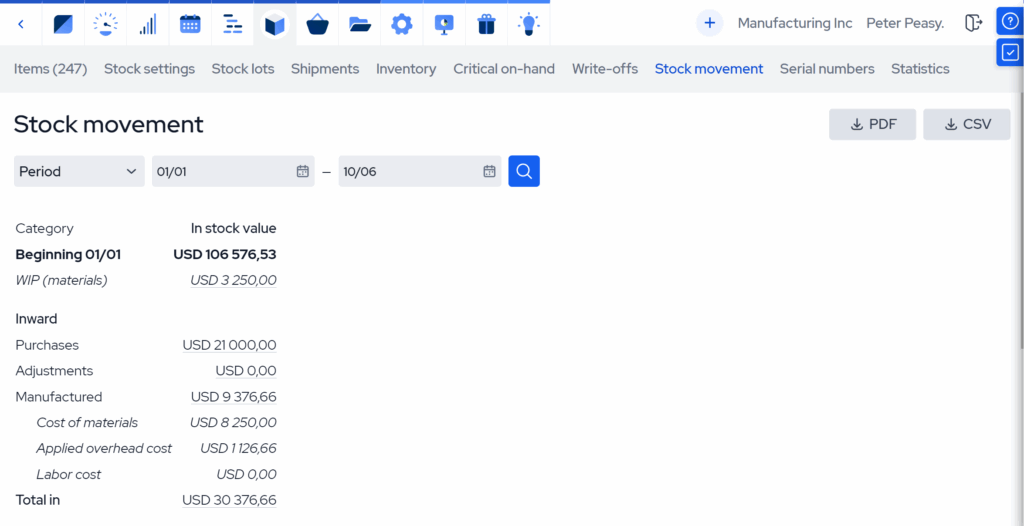
How MRPeasy simplifies inventory valuation
MRPeasy combines inventory, purchasing, production, and costing into one system, so inventory values are updated from the very transactions that create the costs.
- Track actual costs by stock lot. Purchased items retain the cost of their specific stock lot, including applicable additional purchase costs. This means you can follow actual costs instead of assigning a static standard cost to everything in stock.
- Get manufacturing costs as you produce. For manufactured products, MRPeasy calculates actual cost from the materials consumed plus labor and manufacturing overhead recorded against the Manufacturing Order. That gives you a cost trail from purchased components through to the finished product.
- Keep stock movements and costs connected. Receipts, material consumption, completed production, shipments, write-offs, locations, lots, and serial numbers are handled in the same inventory system. You can understand not just how many items you have, but where their recorded value came from.
- Use FIFO automatically for stock allocation. MRPeasy books available stock using FIFO by default, or FEFO for perishable goods, while retaining the actual cost of the stock lots involved.
- See actual product costs and margins. Once products are produced and shipped, you can compare their selling price with actual COGS, including separate material, labor, and manufacturing overhead components for manufactured items.
- Keep accounting in sync. MRPeasy integrates with Xero and QuickBooks Online, including optional synchronization of inventory, WIP, COGS, direct labor, and manufacturing overhead transactions. This reduces the need to manually recreate manufacturing accounting entries in your bookkeeping system.
Frequently asked questions (FAQ)
The four main inventory valuation methods are FIFO, LIFO, weighted average cost (WAC), and specific identification (SI). FIFO assigns the oldest costs first, LIFO uses the newest costs first, WAC averages similar inventory costs, and SI tracks the actual cost of specific items or lots. The best fit depends on how interchangeable your inventory is, how your costs behave, and which accounting rules apply to your business.
When costs are rising, LIFO usually produces higher COGS and lower reported profit, which can reduce taxable income. However, LIFO is permitted under US GAAP but prohibited under IFRS, and the exact tax impact depends on your jurisdiction and accounting setup. Treat it as an accounting and tax decision, not as a way to lower taxes in a given year.
The weighted average cost method is useful when you handle large quantities of interchangeable inventory purchased at varying prices. It simplifies costing by assigning the same average cost to similar units and helps smooth short-term price fluctuations. WAC is especially practical for items such as bulk materials, fasteners, packaging, chemicals, and other standardized components.
Different inventory valuation methods change how costs are split between COGS and ending inventory. When prices are changing, this can affect reported gross profit, net income, inventory assets, and potentially taxes, even when the same quantities are purchased and sold. This is why you should understand not just the method being used, but also how it influences your margins and inventory values in reports.
You might also like: 12 Tips for Improving Inventory Management Efficiency.
Get manufacturing know-how delivered to your inbox!