Agile Manufacturing: A Practical Guide for Small Manufacturers
If you’re a small or mid-sized manufacturer, adopting an agile approach can help you respond to changing customer requirements and fast-moving markets. In this article, you’ll learn what agile manufacturing is, whether it’s a good fit for your business, and how to put it into practice.
What is agile manufacturing?
Agile manufacturing is a production approach used to respond more quickly to changing customer needs and market demands. Originating in the IT sector, agile uses short production cycles and continuous feedback to allow manufacturers to adjust designs, schedules, and processes as soon as conditions change.
This makes agile manufacturing especially useful for manufacturing methods and sectors that routinely grapple with frequent product changes or short lead times. However, it’s worth getting acquainted with agile principles, regardless of the manufacturing type you employ or the industry you serve.
The origins of agile
Agile originated in the information technology industry, where software development teams used it to manage projects that had shifting requirements and unpredictable outcomes. Short development cycles, customer feedback loops, and flexible workflows allowed teams to continuously improve products, instead of planning everything up front.
Manufacturing later adapted these principles to respond faster to changing customer demands, product specifications, and market conditions. But because implementing an agile framework required complex and costly ERP systems, only large manufacturers with big budgets had access to agile systems.
Today, however, agile manufacturing is no longer limited to large enterprises. Cloud-based MRP systems have eliminated the need for expensive infrastructure and lengthy implementation times. These systems offer features like real-time production planning and BOM version control at a fraction of the cost of on-premise ERPs. This allows small manufacturers to operate with greater flexibility and faster time-to-market.
How do agile manufacturing systems work?
The core principles of agile manufacturing
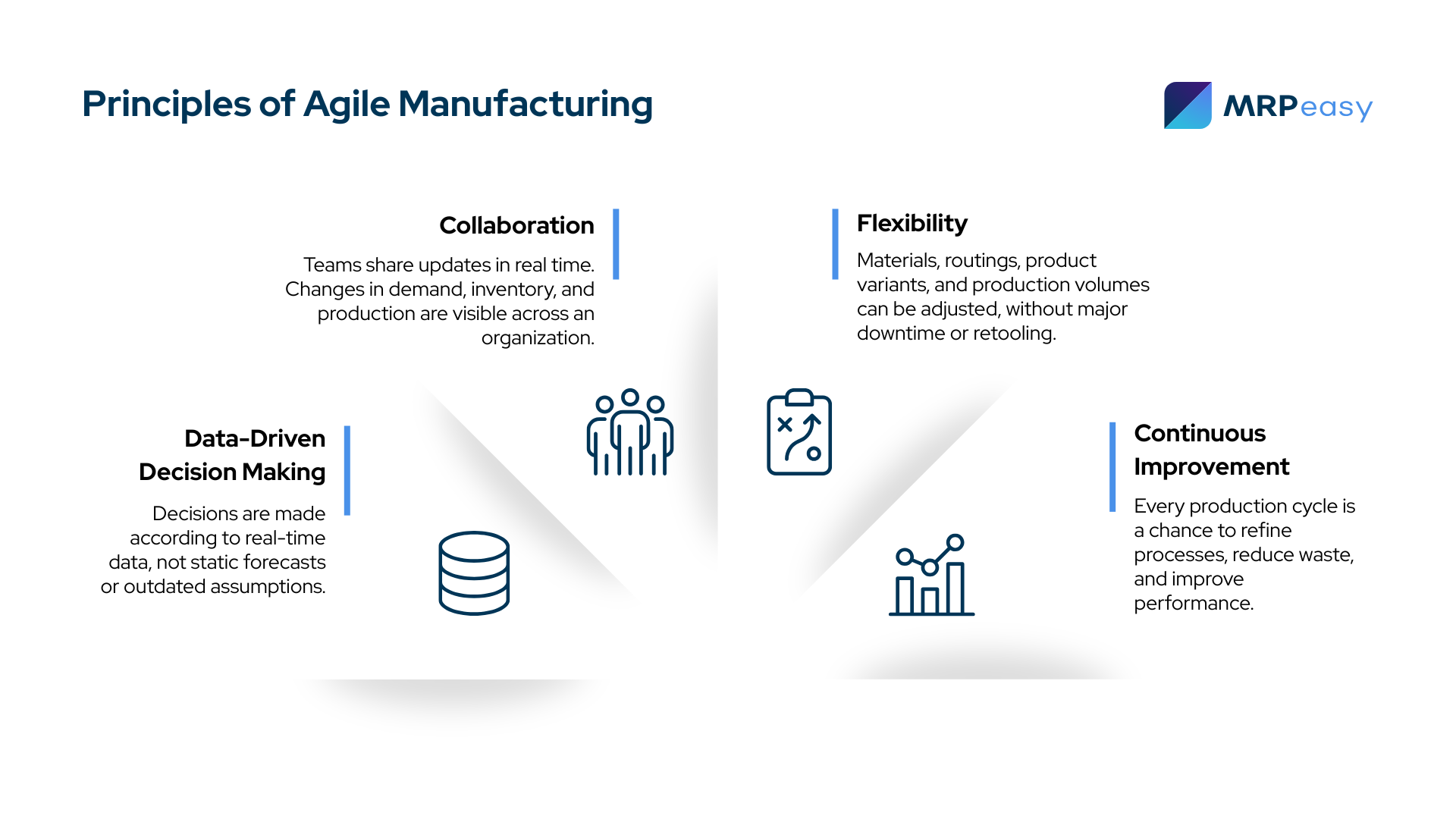
Agile manufacturing systems are built on the following guiding principles, which define how to organize work, make decisions, and respond to change in an agile setup. According to Agile Manufacturing: The 21st Century Competitive Strategy, these principles are applied across three phases: design, planning, and production.
Agile design – iterative specs
Agile manufacturing begins already in the product design stage. In agile, product design should evolve through short, time-boxed iterations rather than a single specification phase.
After each iteration, feedback is gathered from pilot customers, system data, and internal stakeholders. By implementing this feedback into the product’s design, you can build what customers actually want (not what was assumed months earlier).
Collaboration is essential during the design phase. All departments must share their skills, knowledge, and perspectives. Because iteration and refinement are ongoing, the design stage takes longer compared with traditional manufacturing. However, this continuous improvement dramatically increases product quality.
Agile planning – reconfigurations are the norm
Next is the planning phase. Traditional manufacturing relies on fixed, long-term schedules. But with agile planning, production schedules must be designed to be reconfigured and updated on the fly, as conditions change.
Modern manufacturing software plays an important role in this. It enables customer orders to be connected with products’ bills of materials (BOMs), routings, inventory levels, staff availability, and procurement requirements. When anything changes, the system can show you in real-time what can be produced now, what needs to wait, and how the changes will affect delivery dates.
Manufacturing software can make agile planning much easier, but it’s crucial that you provide it with accurate and timely data on production operations, inventory levels, deliveries, etc. When data is outdated, incorrect, or incomplete, your production plans will be off.
Make sure your team is trained to consistently collect and enter data into the system. This way, you can trust your production plans and make the right decisions when changes arise.
Agile production – flexibility above all
The final stage of agile manufacturing is production itself. Whereas traditional workflows prioritize stability, predictability, and efficiency at scale, agile prioritizes flexibility above all. You must be able to quickly switch materials and teams, or reroute tasks, all without shutting down operations.
Responding to disruptions quickly is another central aspect of agile production. If a machine goes down, agile systems are designed to adjust production immediately to reduce downtime and maintain delivery timelines. Similarly, cross-training teams or shifts helps mitigate any disruptions in case of workforce management issues.
Strong communication and real-time data-sharing are crucial during production. They ensure that the right information is being shared and adjustments can be made quickly. With accurate data, you can quickly identify issues (e.g., bottlenecks, delays, or quality problems) and make adjustments before they result in missed deadlines or rework.
While some agile factories use advanced automation during production (e.g., robotics or artificial intelligence), it’s not a requirement. Modern manufacturing ERP software can provide granular visibility into materials, schedules, and work-in-process.
The benefits of agile manufacturing
Agile can bring considerable efficiency and profitability boosts both for make-to-stock and make-to-order operations, but the latter usually benefit more and find agile principles easier to implement. The following benefits remain applicable to all parties concerned.
Response to customer needs
Traditional manufacturing often relies on fixed production cycles. Production is more predictable, but it’s harder to accommodate changes. This can lead to delays, costly rework, or missed customer deadlines when changes do appear. By implementing agile principles, you can introduce product variations, update specifications, or reroute work without slowing down operations or driving up costs. This means better adaptation to rush orders, design changes, or last-minute customizations.
Competitive advantage
Responding quickly to customer demands also presents a significant advantage over competitors. A client looking for a customized product will always prefer a manufacturer that can accommodate requested changes and deliver high quality quickly, compared to a company with more rigid workflows that takes longer to meet the request. This makes agile companies more likely to position themselves as a reliable partner in sectors where both speed and quality are most crucial.
Agile also enables you to respond more quickly to market changes and adapt to supply chain disruptions. If demand spikes or certain materials are delayed, it’s easier to speed up or shift production compared to companies with more fixed production setups.
Improved products
Another benefit of agile is that it lets you constantly refine your products. With this approach, you can prototype, test, gather customer feedback, and improve product designs in rapid succession. Through feedback loops and continuous improvement, products become more aligned with real-world demands.
Optimized production
Most make-to-stock manufacturing relies on forecasts made months in advance, and for very stable workflows, it remains a great option. Still, agile principles enable the planning and execution of production changes more quickly, should a pivot be required, or a market opportunity arise.
Regardless of the manufacturing process, relying on real-time data is crucial for effective decision-making. Buying materials in the right quantities and producing only what’s required when it’s required lowers carrying costs, reduces excess inventory, and frees up cash flow.

Agile manufacturing challenges
Before jumping into implementing agile in your setup, challenges like cultural change, increased planning complexity, and balancing flexibility with control must also be carefully considered.
Cultural change
Agile requires a culture of collaboration. When shifting to an agile setup, employees from all departments will need to communicate more often, make decisions faster, and take shared ownership of outcomes.
This requires a more cross-functional approach compared to the top-down communication style often seen in traditional manufacturing. Expertise, perspectives, and ideas must be shared across departments, and all employees must work together to meet changing requirements or overcome challenges.
A core component of an agile culture is trust and transparency. Employees must feel safe to share their feedback on what’s working, what’s going wrong, and where they think things could improve.
Increased planning complexity
Agile planning is more dynamic than traditional forecasting. Instead of setting a schedule once and following it for months, you’ll need to constantly reassess priorities.
In engineer-to-order shops, where an agile approach is often a prerequisite, manufacturers must be ready to constantly assess customer demands. If a client asks for design changes after production has started, you’ll need to update the BOM, adjust routings, and reschedule work.
Without clear processes and good data visibility, it’s easy to get lost in agile production planning. And if you’re unable to manage the complexity of your system, it will quickly become a liability.
Balancing flexibility with control
Success with agile manufacturing requires a balance between flexibility and discipline. If you react to every small disruption without clear priorities, production can become unstable. For example, constantly shifting schedules to accommodate last-minute customer requests can disrupt other orders and hurt your overall efficiency.
It’s important not to react to every change. Instead, set clear rules for when and how to make changes, and track the impact that your agile practices have on other aspects of your operation.
Read our guide for the Best Manufacturing KPIs To Track in 2026.
Is agile manufacturing a good fit for your business?
Agile is not a one-size-fits-all solution, so it’s important to consider if it’s actually a good fit for your business before implementing agile practices. Generally speaking, agile manufacturing could be a good fit for your business if you:
- Operate in fast-moving or highly competitive markets
- Offer customizable products
- Face regular changes in customer requirements or design specs
- Rely on short lead times to win customers
- Need to continuously improve your products
On the other hand, implementing agile manufacturing processes may be difficult (or even counterproductive) if your business:
- Produces high-volume products with little variation
- Relies on long, fixed production cycles
- Deals with strict regulatory requirements
- Uses highly specialized machinery that cannot be reconfigured easily
- Depends heavily on long-term forecasting
For example, automotive assembly lines are designed for consistency and high output, not constant changes. In these cases, a fully agile setup would do more harm than good.
Best practices for SMEs adopting agile
Here are four top tips for adopting agile principles for small and medium-sized manufacturers and distributors.
Start small
When you start with agile, don’t try to integrate it into your entire operation all at once. Start with one product or process you think could benefit from an agile approach.
Then work with all stakeholders involved to implement agile. Establish a communication protocol, continuously refine your product or process, and identify where agile practices aren’t working. Only after you’ve seen good results or understand why it didn’t work, should you move on to the next product or process.
With this approach, you minimize the risks inherent in implementing new production approaches. You can test agile principles in real-time and experience their benefits and challenges on a small scale. This is much better than immediately moving to a fully agile setup, only to realize it doesn’t work well with your business model.
Prioritize accurate data
Having accurate data depends on clear data collection practices. Every team member, from engineers to shop floor workers, must be committed to reporting and sharing information. When all data is routinely entered into your MRP system or MES (Manufacturing Execution System), the software can use this data to optimize your production plan when last-minute changes occur.
A good example of this is UK-based fluidic component manufacturer Connetika, which uses an MRP system for flexible production scheduling. According to Stephen Elliott, Technical Director at Connetika, the software has made it much easier to respond to change:
“MRPeasy shows us when we’re in trouble. When parts don’t come in and suppliers don’t deliver, we can react quickly and move our production schedule. And we have to do it multiple times a day because that’s how many times we get updates on when materials are coming in. The drag and drop features are also a great help in this.”
Consider a hybrid approach
One common mistake is to see agile as an all-or-nothing approach. In reality, a combination of traditional and agile principles is often best. This allows you to keep structured, predictable processes where they make the most sense and use agile where you need more flexibility.
For example, consider an automotive parts manufacturer selling both safety components and car interior accessories. The safety components have strict compliance requirements, making it difficult to make design changes at the last minute. But the car interior accessories have no regulations, so the company is free to make changes according to customer needs.
With a hybrid approach, the company could forecast production months ahead for the safety components. For the unregulated car interior accessories, they take an agile approach, continuously gathering customer feedback and making product improvements as they see fit.
Build feedback loops into daily work
Agile relies on feedback from both internal and external stakeholders. Therefore, try to build feedback loops into your operations as much as possible.
This could include:
- Quick reports for each production run.
- Post-use feedback from key customers.
- Daily check-ins with shop floor workers.
- A “stop-and-flag” system where operators can pause work and raise issues immediately.
- Tracking rework, scrap, and change requests.
- Reviewing complex or custom jobs.
Manufacturing software is also essential for getting real-time feedback. For example, production planning software can track things like work in progress, BOMs, and materials. When there’s a disruption (like a material shortage), it’s shown in the system right away. This kind of instant feedback makes it easier to identify issues and take action right away.
Examples of agile manufacturing
A custom electronics manufacturer delivering small-batch products
In this scenario, imagine an electronics company producing IoT devices for industrial clients. Customer specifications change frequently due to new compliance rules or added features, forcing the manufacturer to rework designs, update BOMs, and revise production schedules.
This leads to delays, excess inventory from outdated components, and frustrated customers waiting for revisions. To solve these issues, the company decides to take an agile approach.
Originally, the company was finalizing designs upfront and fixing procurement and production. With their new approach, however, they use incremental design and planning. In addition, engineers design modular circuit boards. This makes it easier to swap components without redesigning an entire product. Instead of waiting months for a revision cycle, customers receive updated products in weeks.
The company also updates its procurement process. It expands its list of suppliers and shipping terms, so it can adjust to sudden requirement changes and shorten delivery lead times. After a product is delivered to the customer, they try to get feedback immediately. This feedback can then be used to improve future designs.
A metal fabrication shop using a hybrid approach
Not every manufacturer needs a fully agile setup. Consider a metal fabrication shop that produces both standard components and custom assemblies.
Traditionally, the company used long production plans that worked well for repeat jobs. But this approach caused problems whenever a customer requested design changes mid-order.
Rather than overhaul its entire workflow, the shop decided on a hybrid model. Standard parts continue to run on fixed schedules. At the same time, custom jobs follow short, iterative cycles.
The team also uses its manufacturing CRM to recalculate costs when customer specifications change. The system checks material availability and updates routing without stopping the main production line. This allows engineers to refine custom pieces based on real feedback, while the core business remains stable and predictable.
Key takeaways
- Agile manufacturing is a production approach built on flexibility, rapid iteration, and real-time feedback. The agile methodology helps manufacturers respond quickly to changing customer needs, product specifications, or market conditions.
- In contrast to traditional manufacturing approaches, agile prioritizes adaptability over predictability. Instead of finalizing every detail upfront, agile requires you to refine products and processes in short cycles. This reduces the risk of producing unwanted or outdated goods.
- Modern cloud-based MRP and ERP systems make agile manufacturing accessible to small and mid-sized companies, not just large enterprises. These tools connect sales, purchasing, inventory, and production data so you can adjust schedules, BOMs, or routings instantly when requirements change.
- Implementing agile requires a cultural shift. Successful adoption depends on collaboration, willingness to experiment, comfort with continuous change, and decision-making based on real-time data.
- Agile is not the right fit for every manufacturer. If you have long, fixed production cycles, strict regulatory environments, or highly specialized machinery, you may struggle with a fully agile production process. Many manufacturers benefit from adopting a hybrid approach that applies agile principles only where flexibility creates value.
Frequently asked questions (FAQ)
Lean practices focus on minimizing waste and maximizing efficiency, while agile manufacturing is based on flexibility and rapid adaptation to changing conditions. For example, a lean manufacturer relies on detailed long-term schedules to maximize efficiency. An agile manufacturer continually adjusts plans in real time as priorities or customer needs change.
Yes, agile can be used in manufacturing, and it is increasingly adopted by companies that need the ability to pivot quickly and handle custom or evolving product requirements. For example, a furniture manufacturer offering configurable office desks can adjust production instantly when a customer changes material or size preferences. Agile manufacturing is especially beneficial for businesses operating in competitive markets, producing small batches, or offering custom products.
Waterfall manufacturing follows a fixed, sequential process where designs, materials, and schedules are set up front. It works best for high-volume, repeatable products with stable requirements. Agile manufacturing assumes needs will evolve. Instead of locking in decisions early, teams work in short cycles, use real-time data, and adjust designs, schedules, or workflows as conditions change. This enables a more rapid response to customer or market shifts.
There’s no universal timeline for adopting agile manufacturing. Most companies start with a single product line or workflow and expand once the benefits become clear. Early results, such as shorter lead times or fewer revisions, can appear within weeks. However, implementing agile into all workflows, retraining teams, and refining workflows can take months (or longer).
You may also like: Statistical Process Control – A Manufacturer’s Guide
Get manufacturing know-how delivered to your inbox!