Plastics Molding Company Improves Order Control with Manufacturing Software
Acron Plastics, a New Zealand thermoforming manufacturer, had been running as a fully paper-based business before adopting MRPeasy. “I’ve never once screwed up an order by misplacing or forgetting about something thanks to MRPeasy,” says Business & Sales Manager Mark Wong.
Company: Acron Plastics
Industry: Plastics
Product: Custom vacuum-thermoformed plastic parts and products
Location: Auckland, New Zealand
Previous system: Handwritten documentation and manual spreadsheets
Pain points: Paper-based workflows, reliance on individual knowledge, limited operational visibility, and a lack of a centralized system to support growth
Key functions: Order management, BOMs and routings, production scheduling, manufacturing orders, purchasing, and inventory control
Results: More reliable order execution, fewer mistakes, better operational visibility, improved purchasing and inventory control, and easier on-time customer updates
From custom meter boxes to full-service plastics manufacturing
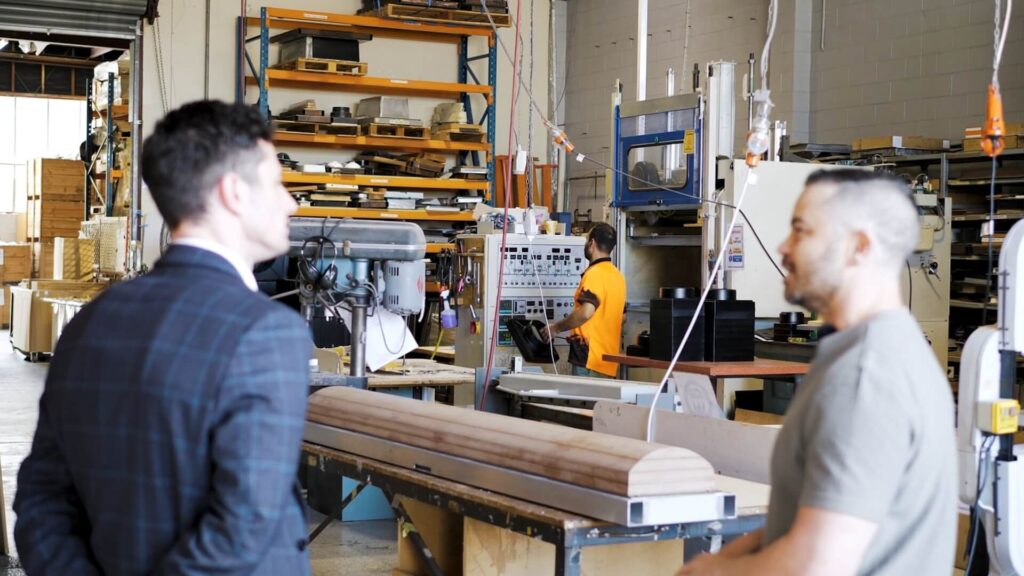
Acron Plastics is a New Zealand-based custom plastics design and manufacturing business based in Auckland. The company offers a range of services, including vacuum thermoforming, CNC machining, fabrication and assembly, product design, and tooling. It serves a broad mix of industries, from food and beverage to retail, marine, healthcare, and agriculture.
Acron Plastics was established in 1989. The founder had been working in a plastics factory when one of its customers needed a custom product that the large plant couldn’t accommodate. The first machines were purchased specifically to produce products – plastic meter boxes, for that first client, and 37 years later, the company still supplies that same customer today.
In terms of scale, Acron sits comfortably between a custom job shop and a mass-production facility. This is thanks to its specialization in vacuum forming, a molding technology perfectly suited to smaller production runs than the more common injection molding. Acron’s typical order sizes range from 30 to 600 units, although they also service orders in the thousands on occasion. More complex parts are handled through CNC machining and trimming. This makes the company a strong fit for businesses whose requirements are too specialized or low-volume for injection molding to make sense.
Learning a manufacturing system after it’s already implemented
For most of its lifetime, Acron Plastics was a fully paper-based business, relying on handwritten documentation and manual spreadsheets to manage stock and orders. That kind of setup can work when the same person holds everything together in their head. But when the company changed owners in 2017, the new management quickly realized that to better navigate, scale, and improve the business, a move to a central digital system was necessary.
When management changed again in 2024, Business & Sales Manager Mark Wong inherited not the software selection process, but the challenge of learning to use MRPeasy, the manufacturing system already set up by previous management. “I didn’t have someone beside me who would properly teach the underlying logic of the system. I had to learn on the go while also getting acquainted with the rest of the business.”
Manufacturing software works best when users understand the logic underneath: stock items, BOMs (bills of materials), routings, purchasing, and how the data connects. As Mark puts it, a good place to start is by entering a stock item and understanding the MRP logic from the ground up, rather than mechanically repeating a set of instructions from a clipboard. He also stresses the importance of clean setup data. If key information is missing or even subtly off during import, the whole workflow can become harder to trust later on, and discrepancies can creep in.
How orders are handled in MRPeasy
Acron Plastics uses MRPeasy as the operational backbone from the moment a quote is accepted. Whenever an order comes in, Mark enters it into the system, along with the right BOM and production routings, and lets the software connect the materials, process times, and job structure. The order is automatically moved into the production schedule, and MRPeasy generates a manufacturing order for it. At the same time, purchase order management and stock control are both handled in the system as well.
“As soon as I put the order in, our work is pretty much automated by MRPeasy,” says Mark. “That’s big for us as we have a lot of variability and customer-specific parts from job to job.” Instead of relying on memory or paper trails, the team now has a structured workflow that starts at order entry and carries through purchasing and production. “It’s incredible for me as I don’t have to rely on remembering all the details! I’ve never once screwed up an order by misplacing or forgetting about something thanks to MRPeasy,” Mark laughs.
And for the customer, the benefit is simple but important – more reliability. “From the customer’s point of view, MRPeasy increases our reliability, reduces mistakes, and simplifies providing them with on-time updates,“ Mark comments, “Delivering on time means happier customers, and that helps with retention.”
The biggest value gains for Acron Plastics
Alongside reducing human error, one of MRPeasy’s core benefits for Acron is better operational visibility. Because the system tracks jobs from quoting through to invoicing and provides a clear view of workloads, it helps management see where the business stands financially and make practical decisions about whether to wrap up current work or win more business to stay profitable. This kind of visibility supports both execution and better day-to-day decision-making.
Another major benefit is more structured order execution. Once an order is entered with the correct BOM and routing, MRPeasy turns it into a clear manufacturing workflow, rather than leaving the team to manage production through paper trails and handoffs. Mark: “The system knows which materials we’re using and how long a job takes, and also calculates costs. Loading an order into MRPeasy is very simple. It spits out an MO, which I’ll summarize on a magboard for a quick glance for the guys.“ It’s a meaningful advantage for a business with significant variability between jobs.
Finally, a large efficiency boost comes from MRPeasy’s purchasing and inventory control. Mark specifically highlights the system’s stock tracking and built-in alerts for missing items, including visual indicators such as color-coded stock statuses in inventory reports that flag when materials are running low. In a process where material shortages can interrupt production and delay deliveries, that kind of warning system removes a lot of friction.
A practical recommendation for other manufacturers
Today, Acron Plastics is already realizing clear value from MRPeasy in order control, purchasing, and inventory, and is preparing to improve additional operational areas like product costing and traceability in the near future. For small manufacturers, progress often happens step by step, as the team builds cleaner data, stronger habits, and a better understanding of what the system can do.
For Acron Plastics, replacing paper with software was only the beginning. The bigger gain came from building workflows that are more reliable, provide more visibility, and reduce reliance on workarounds and manual follow-up. Mark’s advice to other manufacturers is purely practical: “Learn the system properly, not just where to click. Make sure the data going in is complete and that you understand what the system is doing with it. And don’t stay complacent too long – keep expanding the use case over time to maximize the value of what you’re already paying for.”
You might also like: Top 10 Mistakes Small Manufacturers Make with ERP Software
Get manufacturing know-how delivered to your inbox!