What We Learned at IMTS as MRPeasy Reaches 1,000 Active Customers in North America
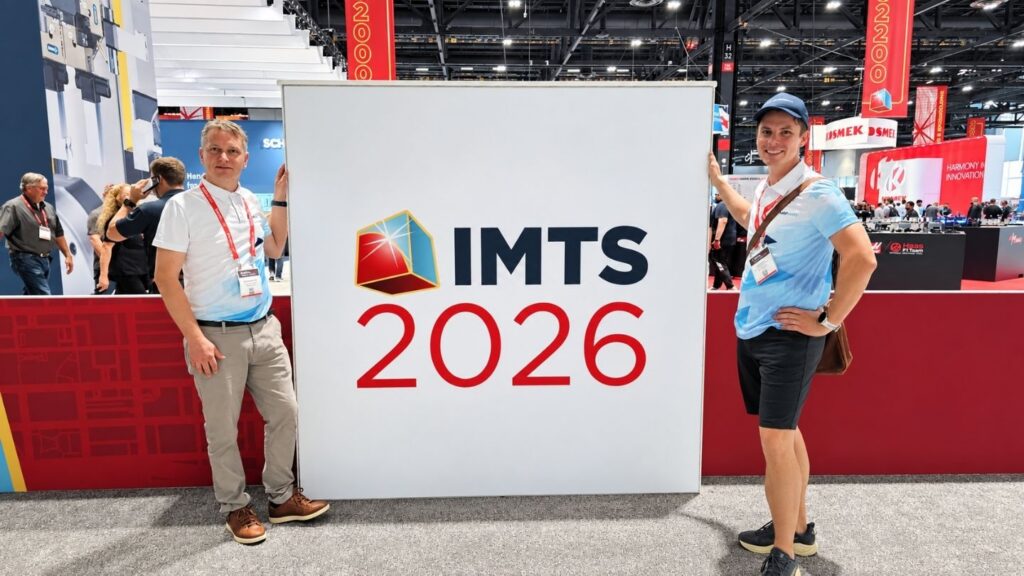
Recently, MRPeasy reached an important milestone: more than 1,000 active customers across North America. So the timing was perfect to visit one of the region’s (and the world’s) biggest manufacturing events – the International Manufacturing Technology Show (IMTS) in Chicago.
Small manufacturing does not mean low-tech manufacturing
Our first major US manufacturing expo in roughly a decade, the IMTS showed us how much has changed in the small manufacturing world over the past 10 years.
The stereotypical small factory is still often imagined as a relatively manual operation running on aging machinery, paper documents, spreadsheets, and knowledge stored in employees’ heads. While those factories do still exist, they increasingly represent only part of the SME manufacturing landscape.
At IMTS, we saw comparatively small companies operating in highly sophisticated production environments. Modern CNC machinery, robotics, CAD/CAM systems, machine monitoring, production scheduling, and digital quality tools are increasingly common even among companies with only a few dozen employees. Company size, therefore, no longer determines a business’s technological sophistication.
The modern factory is becoming a technology ecosystem
Another thing that stands out at an event like IMTS is just how specialized manufacturing software has become.
A manufacturer may rely on an array of different systems:
- CAD and CAM systems for product design and machining;
- Product lifecycle management software for engineering data and revisions;
- Quality management systems for inspections, documentation, employee training, and compliance;
- CMMS platforms for maintaining production equipment;
- Advanced scheduling tools for optimizing increasingly complex production environments.
Many of these systems solve specific problems that a general-purpose manufacturing ERP system should probably never attempt to solve in the same depth. For smaller manufacturers especially, it makes more sense to think of the factory as a technology stack rather than expect one enormous system to control everything.
ERP or MRP can be at the center, connecting customer orders with purchasing, inventory, production, costing, and delivery. Specialist software can handle areas where deeper functionality is required. As these technology stacks grow, however, whether the systems talk to each other matters as much as how good their individual functionality is.
ERP can still be too expensive to implement
Our conversations at IMTS demonstrated an interesting contrast. Manufacturing technology has evolved at breakneck speed, but buying and implementing manufacturing software can still feel surprisingly old-fashioned.
Many ERP systems rely on consultants to configure, customize, train, and implement them. There is nothing inherently wrong with this, and a large manufacturer with hundreds of employees, unusual processes, and a dedicated IT team may need exactly that.
However, it becomes increasingly difficult to justify as the customer’s employee count falls below a few hundred, because the software license is often only the beginning of the bill. Mandatory implementation packages in the US can start in the five figures, with additional costs for consulting, customization, training, and support.
And money is only half of the story. An ERP project requires time from managers, production staff, finance, purchasing, and others who already have day jobs. A smaller manufacturer feels that disruption much more acutely than a company with a dedicated implementation team.
This is where standardized cloud software has a real advantage. If most manufacturers share many of the same requirements, it should be possible to meet those requirements without rebuilding the system for each new customer.
Small manufacturers do not need to settle for less
None of this means smaller manufacturers have to settle for only the most basic functionality.
Manufacturing is complicated regardless of the manufacturer’s size. Basic systems meant for accounting or inventory management may handle basic stock, but not how materials are consumed to create finished goods, how purchases tie into production plans, or how costs are incurred as production progresses.
This leaves a sizeable gap in the market: on one side are relatively simple inventory and accounting tools, on the other are highly configurable manufacturing systems with expensive implementation projects to match. Many manufacturing SMBs, however, sit somewhere in between.
They still need proper BOMs and routings, production planning, purchasing, traceability, costing, and inventory control. And that is the part of the market we have concentrated on. Our approach is to provide the manufacturing functionality first, while keeping implementation and the cost of ownership realistic for a smaller company.
Reaching more than 1,000 active customers in North America, with around 850 of those based in the United States, gives us a fairly good indication that there are plenty of manufacturers looking for that middle ground.
The value of showing up at the show floor
IMTS 2026 gave us plenty to think about. With around 1,800 exhibitors, we spent three full days walking the show floor. Skipping a booth and focusing instead on customers, partners, other software companies, and what manufacturers were actually paying attention to turned out to be the right call.
There is real value in getting out of the office and going where your customers operate. Seeing modern manufacturing firsthand reveals things that are hard to pick up from dashboards, surveys, or support tickets.
The trip also confirmed where MRPeasy fits best. We sit between spreadsheets, accounting tools, and basic inventory software on one side, and highly specialized manufacturing systems with long implementations and significant consulting costs on the other.
That middle ground matters especially for manufacturers with fewer than 200 employees. These companies can have sophisticated production processes, but still need software they can adopt quickly and affordably. That is the model MRPeasy is built around: serious manufacturing ERP/MRP functionality without a long, expensive implementation.
A big thanks to everyone we met in Chicago: for the good company, the interesting conversations, and the useful insights!
Get manufacturing know-how delivered to your inbox!