Manufacturing Cost Control Guide for SMBs
Manufacturing cost control is about more than simply cutting expenses. It’s an ongoing process of setting realistic cost expectations, monitoring variances, and making adjustments to keep spending within acceptable limits.
What is manufacturing cost control?
Manufacturing cost control is the continuous process of setting cost standards for materials, labor, and overhead, tracking actual costs against those standards, investigating variances, and making adjustments to keep costs in line with budgets and overall organizational goals.
Cost control vs cost reduction in manufacturing
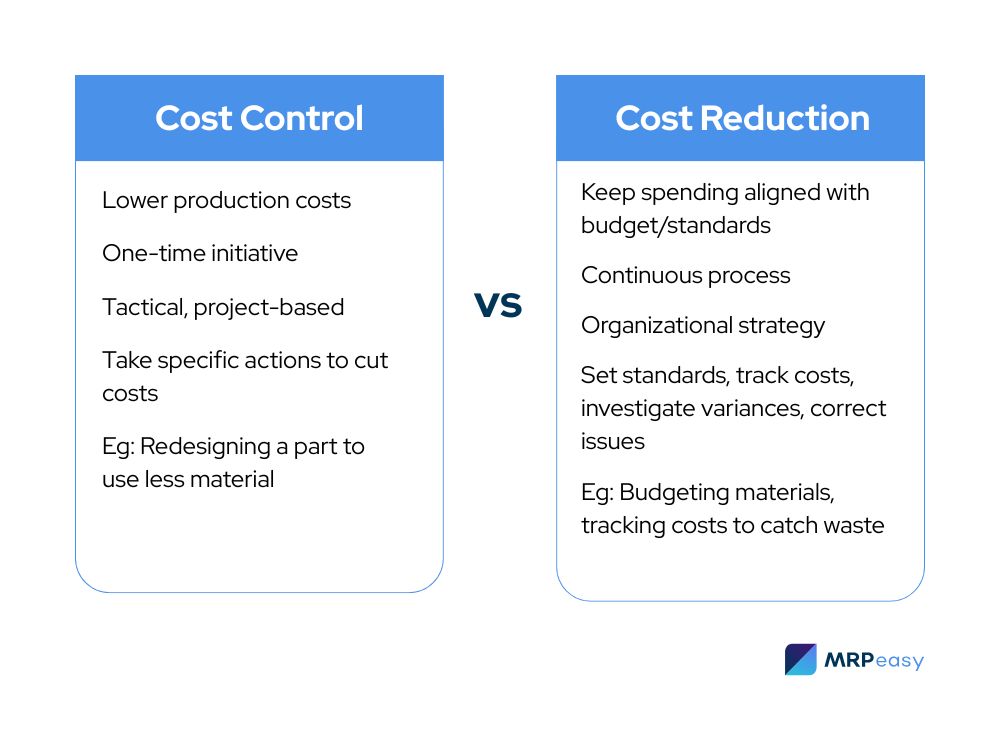
Cost control and cost reduction are closely related, but there’s an important distinction between the two.
Cost reduction is strictly focused on finding ways to reduce manufacturing costs without sacrificing product quality. For example, cost reduction could be redesigning a part to use less material, minimizing waste, or automating production to reduce labor per unit. Cost reduction is typically a one-time, project-based initiative
Cost control is the process of setting cost baselines and monitoring actual costs to keep them within acceptable limits. For example, a manufacturer may estimate the material, labor, and overhead required to make a specific product. Cost control means tracking those costs, investigating any cost variances, and correcting issues such as excess waste, scrap, overtime, or inefficient machine use to keep costs under control.
Why cost control matters for manufacturers
Cost control in manufacturing industries is essential because raw material, labor, energy, and overhead costs are constantly fluctuating.
Even small overruns can quickly erode margins when repeated across multiple production runs. Cost control keeps costs within acceptable limits and protects margins. In addition, it can also lead to:
- Better decision-making: An accurate, up-to-date view of costs leads to better decisions on pricing, production volumes, and process changes.
- Reduced waste: Cost variances can reveal excess material usage, scrap, rework, idle time, and inefficient workflows. Cost control forces you to address the underlying cause of waste before it becomes a recurring expense.
- Flexibility: Good cost control makes it easier to adapt to changing market conditions, absorb temporary cost increases, and compete on price without risking profitability.
Without cost control in place, it’s difficult to spot cost overruns or know why actual costs are higher than expected costs. You also run the risk of pricing products based on outdated assumptions or accepting unprofitable orders without knowing it.
How to implement cost control in manufacturing
1. Make cost control an organizational goal
Applying cost control methods in manufacturing requires buy-in from all parts of a business, not just finance or management. Every employee needs to understand how their daily decisions affect costs and have clear responsibilities when it comes to cost control. For example:
- Production managers are responsible for tracking labor and machine efficiency
- Finance teams handle cost variance analysis and budgeting
- Procurement teams monitor material costs and supplier performance
When every employee considers cost control in their daily work and is aware of their responsibilities, they become better equipped to spot inefficiencies and suggest improvements. Without clear ownership, cost tracking becomes inconsistent and issues get overlooked.
Setting cost control as an organizational goal is the first step, but a business also needs tools that let all employees work from the same information. If costing data lives in multiple disconnected systems, teams will have an inaccurate view of costs, and sharing cost data becomes so difficult that people stop doing it.
A dedicated MRP system connects cost data across departments, so that everyone has easy access to the most up-to-date information.
2. Maintain accurate cost data
Accurate data is the foundation of good cost control. If your bills of materials (BOMs), routings, and labor/machine rates are outdated or incorrect, every downstream cost calculation, variance analysis, and pricing decision is going to be based on faulty assumptions.
For example, consider a packaging manufacturer switching to a more expensive grade of cardboard for their carton design. They forget to update the BOM, and so their manufacturing software calculates product costs using the old material price. As a result, the product cost is understated, and their sales team prices the product too low.
To make sure everyone is working from the most accurate information, costs should be stored in a manufacturing ERP with integrated BOM software. This way, updates to BOMs, routings, and rates are then reflected across the business, reducing the risk of departments relying on outdated figures.
Change management policies also keep cost data accurate. For example, you can put a policy in place that requires all changes to products to be updated in the relevant BOMs before any changes are introduced on the shop floor.
Keeping data accurate is a constant process. Schedule periodic reviews to make sure BOMs, routings, and rates are up to date, and catch small changes before they have a big impact on your business.
3. Determine expected product costs
Cost baselines are the expected costs of producing a single unit under normal conditions. Having a cost baseline is essential to cost control, because you can’t spot a variance if you don’t know what the cost was supposed to be in the first place. To calculate your baseline, break down what it actually costs to produce each unit, including:
- Direct materials
- Direct labor
- Allocated overhead (variable costs like energy and machine operation costs; fixed costs like rent and equipment depreciation).
When setting your cost baselines, make sure they reflect realistic operating conditions, not best-case scenarios. This means accounting for normal levels of scrap, setup time, and machine downtime, rather than assuming everything will run perfectly.
Once you’ve set your cost baseline, you can use it to calculate the selling price needed to cover expected costs and achieve your target margin.
Your cost baseline can also be used to create an operational budget. Multiply your expected unit cost by the planned production volume, and add the relevant fixed and variable overhead. Your budget helps you set clear spending limits and resource allocation for materials, labor, and manufacturing overhead.
4. Track actual vs expected costs
Next, compare your actual costs against your baseline. If actual costs are higher than expected, that signals a variance you should review.
KPIs can be useful when tracking both indirect and direct costs. Rather than reviewing every cost line individually, a small set of KPIs gives you a quick read on whether costs are staying within their limits. Some common manufacturing KPIs for cost control include:
- Cost per unit
- Scrap rate
- Labor efficiency
- Overhead as a percentage of revenue
For each KPI, set a target, acceptable variance range, and review timeline. For example, you might set a target scrap rate of 2%, with an acceptable range of up to 2.5%, and monitor scrap rates every week to make sure they stay within this limit.
5. Assess cost variances
If your actual costs differ from expected costs, you need to determine whether the variance is normal or requires corrective action.
When deciding whether a cost variance requires action, consider the size of the variance and its frequency. For example, a minor variance that shows up once can probably be ignored. Small fluctuations are common in manufacturing due to changes in material prices, production times, energy use, and operational efficiency.
On the other hand, a large one-time overrun might be worth looking into because of its immediate financial impact. Small but frequent overruns can also point to a deeper issue in your production processes, costing assumptions, or planning.

6. Find the root cause of overruns
Material, labor, overhead, scrap, and rework variances each point to different parts of the production process.
Therefore, it’s helpful to consider the category of each cost variance when trying to find the root cause of the issue. For example, recurring variances in scrap rate may point to underlying issues like worn tooling, incorrect machine settings, or unclear work instructions. Other patterns include:
- Material cost variances: often caused by supplier pricing changes or excess material usage.
- Labor cost variances: come from overtime, bottlenecks, or inaccurate routing.
- Overhead cost variances: signal higher machine, energy, or maintenance costs.
Lean manufacturing principles can also support this step. While Lean is usually considered a cost reduction methodology, its principles can be useful in understanding where cost variances come from and how to fix them.
For example, imagine labor costs run higher than expected. Using Lean tools, such as value stream mapping, you can spot the bottlenecks in your production that are driving up labor costs.
Then, Lean root cause analysis (RCA) tools can help you understand why the bottleneck is occurring, whether it’s a staffing gap, equipment slowdown, or an inefficient handoff between steps.
7. Take corrective action
Once you’ve evaluated a cost variance and identified the underlying cause, the next step is to take corrective action. Depending on the issue, the appropriate change might include:
- Improving a production process to reduce material waste, delays, or rework.
- Renegotiating supplier terms to lower material and purchasing costs.
- Providing additional training to reduce errors, scrap, and rework costs.
- Automating a repetitive workflow to reduce labor cost per unit.
In some cases, there aren’t any adjustments to make to your production process. An operation may be performing normally, and the standard itself may be outdated. Supplier prices, wage rates, equipment costs, and normal output levels can all change over time.
When this is the case, the appropriate response is to update the relevant cost baseline and budget, so that future comparisons remain realistic.
8. Make cost control an ongoing process
Cost control isn’t a one-time initiative, but an ongoing process. After you evaluate cost variances and make the necessary adjustments, continue monitoring relevant costs and KPIs to see if your corrective actions made an impact.
If cost variances disappear and performance remains stable, the corrective action you took should become a part of your standard procedures.
For example, if a new inspection step lowers rework, include it in the regular quality control process. If cost variances persist, then review your actions, reconsider the underlying cause, and make further changes as needed.
Make sure to monitor costs for all products, not just those that have recently exceeded their cost targets. The process also requires collaboration from all departments. For example:
- Purchasing tracks material prices.
- Production monitors labor, scrap, and machine performance.
- Finance reviews variances.
As costs and operating conditions change, cost baselines should be updated accordingly, and the process of monitoring, evaluating, and adjusting should continue.
Cost accounting methods for manufacturers
To have good cost control, you need a consistent method to calculate and allocate production costs. Standard costing, activity-based costing, and job order costing each approach costing differently, making them suitable for different types of manufacturing.
Standard costing
Standard costing is where you set predetermined costs for materials, labor, and overhead based on normal operating conditions. Standard costing is ideal for repetitive production processes and relatively stable products (e.g., assembly lines, food production, or component manufacturing).
Standard costing makes variance analysis straightforward because actual costs can be compared directly against clearly defined expectations. Any difference is immediately visible and can be broken down clearly into material, labor, or overhead variances. The downside is that standards become outdated if processes, materials, or suppliers change frequently.
Activity-based costing (ABC)
Activity-based costing allocates overhead costs based on the actual activities that drive costs, rather than using broad allocation methods. For example, instead of spreading setup costs evenly across all products, ABC assigns a larger share of setup costs to products that require frequent changeovers.
ABC works well if you have a range of products that consume resources very differently or if overhead makes up a large portion of total operating costs. It’s also useful for understanding the cost of low-volume or complex products. The tradeoff is that it requires more data collection and admin work than standard costing.
Job order costing
With job order costing, you can set costs for each individual job, batch, or custom order, rather than averaging costs across production. Each job gets its own cost accumulation, showing exactly which materials, labor, and overhead went into that specific order. Job order costing is essential for custom manufacturers, fabricators, or anyone doing make-to-order production where each job is unique.
How manufacturing software improves cost control
An MRP system can help with cost control at every stage of production, from estimating a job before it begins to calculating the final cost of finished goods and understanding variances.
Estimating costs
Using an MRP system, you can calculate a detailed cost estimate based on current bill of materials (BOM) prices, routings, labor rates, and overhead rates. You can run a cost estimate directly from a customer order to set prices, review target margins, and determine whether an order is profitable before production begins.
Tracking actual production costs
MRP software also tracks material consumption, labor, and overhead as production takes place. When parts are booked to an order, the system reserves them and assigns their recorded cost to the job. As materials are consumed, their costs are added to the manufacturing order, updating work-in-progress and actual job costs.
MRP software with a barcode inventory functionality makes this process more efficient by allowing employees to scan materials as they are used, which instantly marks them in the system as consumed.
Shop floor workers can also log their time through a mobile device, and the system will allocate direct labor costs to work in progress and apply any overhead to the job.
Monitoring variances
Manufacturing software can help you track variances during production. If workers consume more materials than planned or an operation takes longer than estimated in the routing, the variance immediately becomes visible in the system.
You can see how actual costs are trending against expected costs, investigate the cause, and take corrective action. This means you can spot runaway costs while production is still in progress, rather than discovering the overrun after the job is finished.
Calculating cost of goods sold (COGS)
When a production order is completed, the system uses the recorded material, labor, and overhead costs to calculate the actual unit cost of the finished product. Finished goods are then added to inventory at their recorded cost.
When products are sold, the same data can be used to calculate cost of goods sold (COGS). This gives accounting an up-to-date view of gross margins and profitability, and makes it easier to understand how cost variances affect financial performance.
Analyzing cost performance
An MRP system also makes it easier to review and understand cost data through dashboards, reports, and data analysis tools.
Dashboards provide an overview of key performance indicators and operational performance at any given moment. They can point to bottlenecks, production backlogs, inventory issues, and sales trends, helping you spot inefficiencies that could be increasing costs.
Cost variance reports compare actual and estimated production costs. If a manufacturing run goes over budget because of higher material consumption or labor hours, the report highlights where the variance occurred.
Tait Farm Foods is an example of the benefits of ERP for cost control in food manufacturing. Previously, the company reviewed product costs and prices only once a year. Now, with the cost analysis features that come with MRPeasy, it can continuously monitor ingredient and labor costs and respond as conditions change.
“I used to spend hours trying to figure out the performance of our products and their costs and documenting them in spreadsheets,” says Production Manager Mattern-Klinger. “Now we know exactly what it costs us to make our products, and we can increase or decrease our prices as we go along.”
Sharing data across departments
Manufacturing software ensures everyone in your organization is working from the same data.
Instead of working from multiple tools or disconnected spreadsheets, everyone uses the same integrated system and any changes can be seen across departments.
For example, if a material price increases, sales can see the effect on margins and adjust pricing. If a BOM changes, purchasing and production can work from the updated cost.
This helps teams spot issues sooner, coordinate their response, and make decisions using the same current information.
Key takeaways
- Cost control and cost reduction serve different purposes. Cost reduction focuses on lowering production costs, often through specific initiatives such as reducing labor costs through automation. Cost control is a broader strategy focused on continuous improvement and keeping spending within acceptable limits.
- Accurate cost data is essential. BOMs, routings, supplier prices, labor rates, and machine rates all contribute to product cost calculations. Regularly review cost data and implement change-management policies to keep cost data accurate and up to date.
- Cost baselines need to reflect realistic operating conditions. Standards based on perfect conditions create constant unfavorable variances and provide little practical value. Realistic baselines make it easier to set achievable budgets, determine target margins, and identify genuine cost problems.
- Consider the size and frequency of a variance before taking action. A small one-time variance may simply reflect normal cost fluctuations and require no action. Prioritize large overruns that can have an immediate effect on profitability,and small recurring variances can gradually erode margins across many production runs.
- MRP software ensures everyone works from the same up-to-date information. It also enables real-time cost tracking by letting workers record material usage, labor, and production activity as they occur. This makes it easier to spot cost changes early and coordinate a faster response.
Frequently asked questions (FAQ)
What is an example of cost control in manufacturing?
An example is a metal fabricator controlling costs for a steel bracket. The expected cost of the bracket is $24: $12 in materials, $8 in labor, and $4 in overhead. The manufacturer tracks actual materials, machine time, and labor. When the actual cost reaches $29, they do a root cause analysis to identify excessive tool-change time as the cost driver. The company reorganizes the workstation to reduce tool-change time and continues tracking costs to measure the improvement.
How to control costs in a manufacturing company?
Manufacturing cost control starts with setting realistic product cost baselines that account for materials, labor, and overhead. Next, compare actual costs against those standards. Review any significant or recurring variances, identify their root causes, and take corrective action. When the underlying cause cannot be corrected because operating conditions have permanently changed, update the baseline. Cost control is a continuous cycle of setting standards, measuring results, and making adjustments.
How does inventory accuracy affect manufacturing costs?
Inventory accuracy is closely tied to manufacturing costs. Material usage, purchasing decisions, and product costs all depend on reliable stock records. For example, if components are used but not recorded, a product’s actual cost may be understated. Inaccurate inventory records can also lead to excess inventory and higher carrying costs.
You might also like: Manufacturing Cost Reduction – A Practical Guide For Small Manufacturers
Get manufacturing know-how delivered to your inbox!