ERP Statistics: Insights From 70 Manufacturing Case Studies
We analyzed 70 customer case studies to better understand what pushes small manufacturers toward ERP software, what challenges they encounter during implementation, and what benefits they see after going live.
ERP implementation statistics at a glance
Most small manufacturers don’t wake up one day and decide they need an enterprise resource planning (ERP) system. The need usually builds over time. Spreadsheets become harder to maintain, stock levels become less reliable, or important information gets too scattered across different tools and people.
To understand what drives ERP adoption and how implementation affects these businesses, we reviewed manufacturers across food, electronics, aerospace, precision components, and automotive manufacturing.
Our research sheds light on why small manufacturers adopt ERP software, what challenges arise during implementation, how long implementation takes, and what benefits they see after going live. Here are some of the key takeaways:
- 74% of small manufacturers lack operational visibility before switching to ERP
- 64% rely on spreadsheets before adopting ERP software
- 82% report improved inventory accuracy after implementation
- 81% report reduced administrative work
- The median ERP implementation time for small manufacturers is 2 months
- Companies with 10 or fewer employees had a median implementation time of 1 month
How we conducted the research
All of the case studies used for our research were based on interviews with MRPeasy customers.
During the interview process, we asked our clients why they decided to implement manufacturing ERP software, what tools they were using before making the switch, what their implementation process looked like, and the main benefits they saw post-implementation.
- Sample size: 70 MRPeasy customer case studies
- Company type: Small manufacturers
- Company size: Median of 15 employees; range 1–200 employees (employee count known for 55 companies)
- Locations: North America, Europe, the Asia-Pacific region
- Limitations: The sample is limited to MRPeasy customers who agreed to participate in the case study, so the results may overrepresent successful ERP implementations
How are small manufacturers managing production before switching to ERP software?
Because our clients vary by size and industry, the ways in which they manage production can also vary greatly. It’s also important to note that many companies rely on more than one tool or workflow.
For example, before switching to MRPeasy, Oceanic Saunas was using a combination of spreadsheets and accounting software to manage production.
According to our research, here are the most common ways small manufacturers manage their operations before adopting ERP software.
- 64% of small manufacturers rely on spreadsheets before switching to an ERP system
- 18% use paper-based systems
- 50% rely on accounting software like QuickBooks or Sage
- 8% have a dedicated inventory management system
For small manufacturers, managing production using these tools may work well at an earlier stage. However, operational efficiency begins to suffer when order volumes increase, products become more complex, or production schedules become too difficult to manage manually.
Why small manufacturers switch to ERP software
The reason a small manufacturer may adopt ERP software varies from business to business.
The most common issue, reported by 74% of small manufacturers, was a lack of visibility into operations. 54% of small manufacturers said they switched to ERP because they outgrew spreadsheets. In addition, 52% cited the administrative burden created by their existing systems, 37% pointed to multiple disconnected tools, and 35% reported lead time issues.
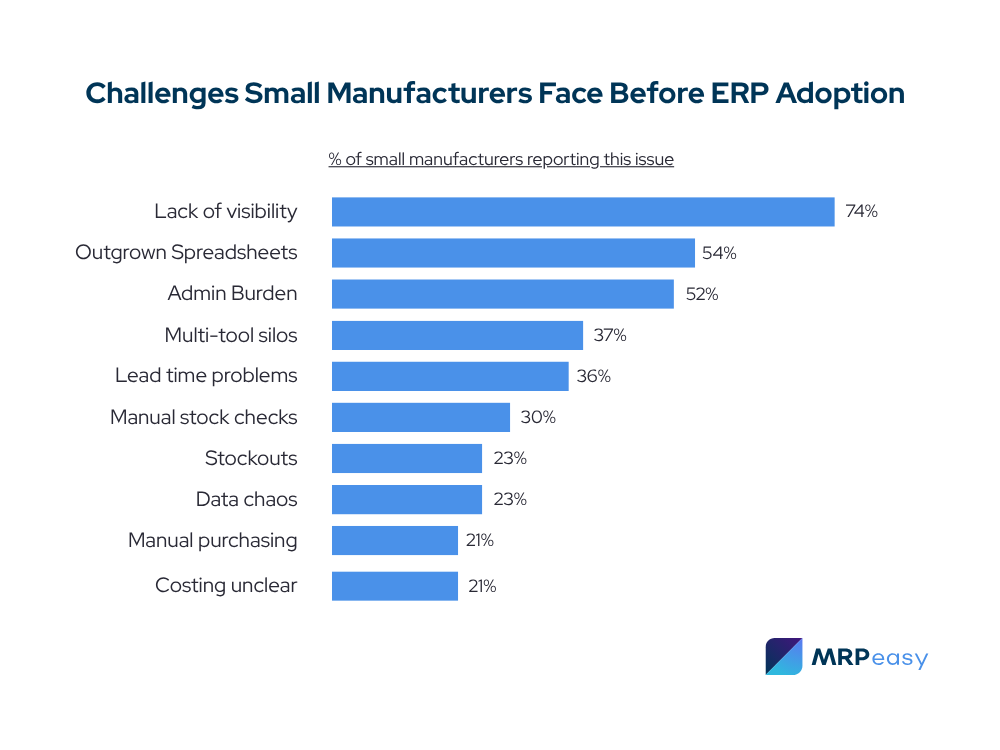
These results align with what we see with customers. Small manufacturers are rarely looking for ERP software simply for the sake of modernization. Instead, they’re adopting ERP software to solve problems like operational chaos, lack of visibility, and spreadsheets breaking down.
“Sage didn’t have the capacity for production scheduling – so to that end, we used Microsoft Excel,” says Chris Landen, Managing Director at Exacta Technologies. “The manual data inputs made the system prone to mistakes, and we knew it was not scalable; finally, we felt we had reached a limit.”
Benefits of ERP implementation for small manufacturers
All clients in our study noted improvements after implementing ERP software, in one form or another. However, benefits vary from business to business and depend on factors like company size, industry, and the specific problems they’re trying to solve.
Here are the most common benefits of implementing ERP software for small manufacturers:
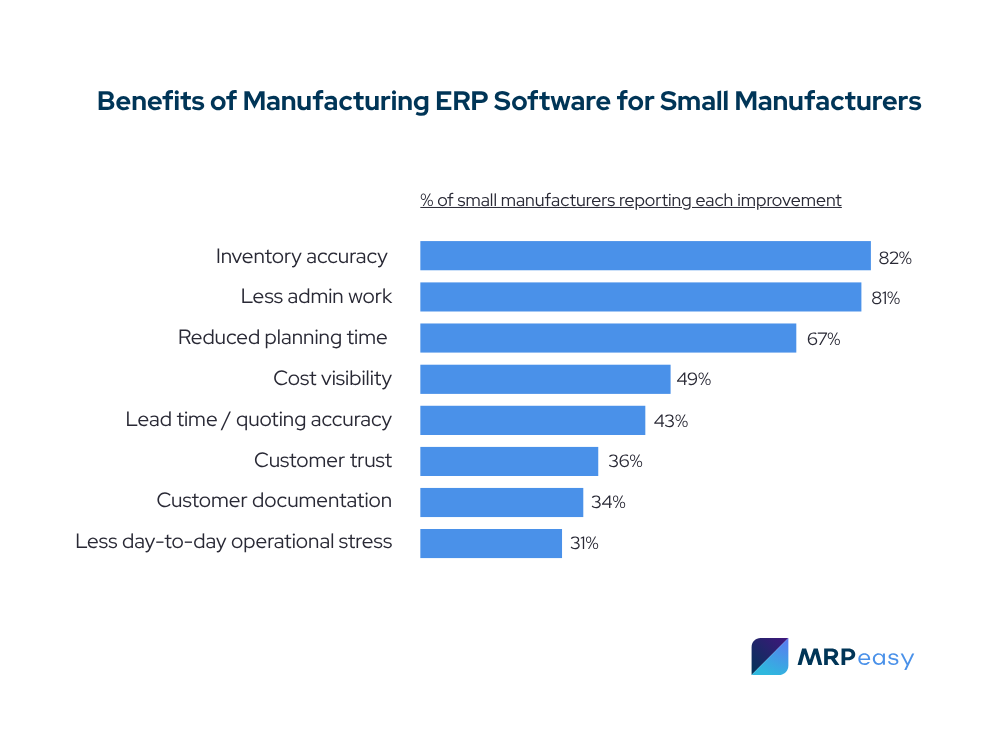
- 82% of small manufacturers said that ERP software improved inventory accuracy
- 67% said that production planning time was reduced
- 49% noted an improvement in cost visibility
- 43% reported improvements in lead time accuracy and quoting
Many ERP systems also include customer relationship management (CRM) functionality, allowing manufacturers to manage customer records, quotes, sales orders, communications, and order histories alongside production and inventory data.
In our research, 36% of small manufacturers reported increased customer trust after implementing ERP software, while 34% noted improvements in customer documentation.
ERP implementation can also reduce the administrative burden on employees. 81% of small manufacturers in our study said ERP software has significantly reduced administrative work. 31% said ERP software has reduced day-to-day operational stress.
“Even though it’s still relatively new, the benefits are already incredible. Time savings are enormous; the system makes everything so quick,” says Tony Green, Founder of Bradenham Preformed Wood Components. “If we’d kept the old system, I don’t know how much time we would have lost scaling up.”
Not all benefits were noticed immediately. In many cases, as teams use their ERP system more and more, they find new ways to improve daily operations.
“We saw the potential of MRPeasy from the start and everyone is learning new things about what it can do each day to improve our business,” says Tyler Hoosier, General Leader of Value Added Packaging. “And everyone really uses the software: from the office workers to the factory floor, everyone interacts with it.”
Common ERP implementation challenges for small businesses
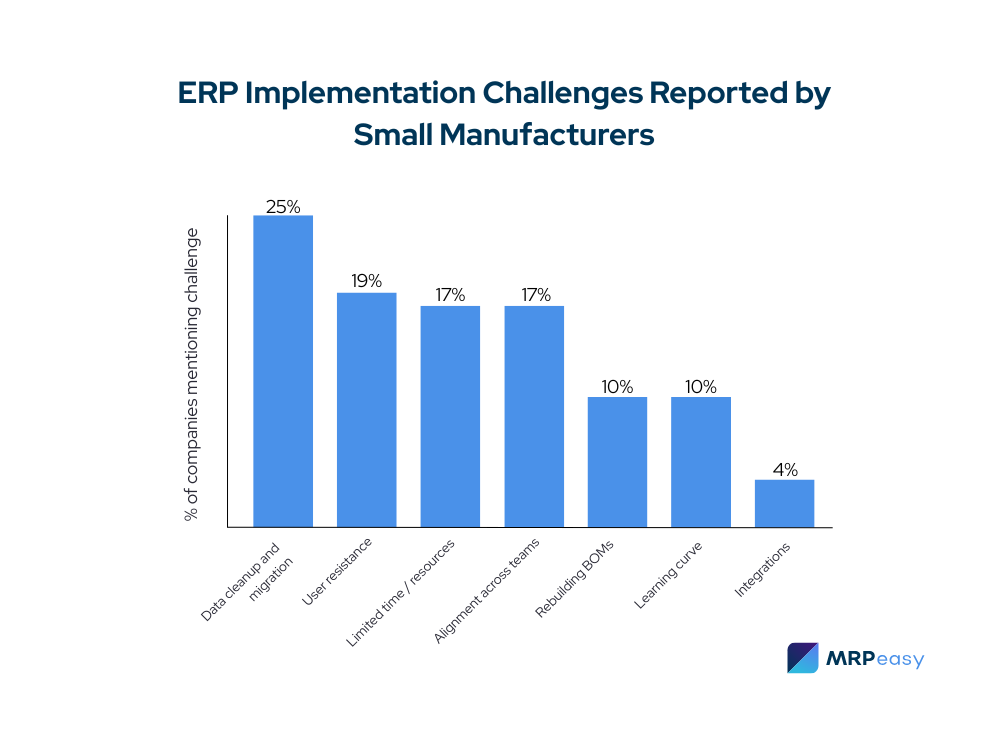
While cloud ERP software like MRPeasy can make implementation more straightforward, it can still be difficult to move from disconnected tools or spreadsheets to a more structured system. According to our research, the following ERP implementation challenges are common for small manufacturers:
- 25% of small manufacturers cited data cleanup and migration as a major challenge
- 19% mentioned employee resistance
- 17% cited limited time and internal resources
- 17% said that internal alignment across teams made implementation difficult
Less common challenges included rebuilding BOMs and the learning curve when adopting the new system, both of which were reported by 10% of small manufacturers. Problems with integrations appeared less often, with only 4.3% of small manufacturers mentioning this as a challenge.
Overall, the findings suggest that the primary barriers to successful ERP implementation are data preparation and organizational readiness, rather than software complexity itself.
How long ERP implementation takes for small manufacturers
ERP implementation is often associated with long timelines, particularly for large-scale systems such as Oracle and NetSuite. However, cloud-based platforms like MRPeasy can make the process more manageable for small manufacturers, helping reduce implementation time and limit the risk of budget overruns.
Of the 70 customers in our study, 46 reported their implementation timelines. Here’s what we found:
- ERP implementation time ranged from 2 days to 12 months
- The median implementation time was 2 months
- Average implementation time was 14 weeks
Implementation also largely depends on company size. Larger companies typically need more time for process customization, data migration, and team alignment. They also tend to have more employees to train and more products, parts, and BOMs to manage. Here are the median ERP implementation times, based on company size:
- 10 or fewer employees: median implementation time of 1 month
- 11–25 employees: 2 months
- 26–50 employees: 3 months
- 51+ employees: 6 months

Summary
Our research suggests that ERP implementation among small manufacturers is usually driven by practical operational pressure rather than broad digital transformation goals or cost-saving initiatives. Most companies switch to ERP software only after outgrowing spreadsheets, accounting software, paper-based systems, or disconnected legacy systems.
The most common benefits were improved inventory accuracy, reduced administrative work, faster planning, and better cost and lead time visibility. At the same time, the main implementation challenges involved data cleanup, change management, and limited internal resources.
Our findings show that ERP implementation can be manageable when the system fits a company’s size and project scope, data is prepared before going live, and teams are aligned across an organization.
You may also like: MRPeasy Users Report 58% Better Inventory Accuracy, 46% Higher Operational Efficiency
Get manufacturing know-how delivered to your inbox!